The table is a meeting place, a gathering ground, the source of sustenance and nourishment, festivity, safety, and satisfaction. A person cooking is a person giving; even the simplest food is a gift.
Laurie Colwin
Last Sunday, a group of sailors from the naval training base just a few miles from our store stopped by to pick up some books for their precious free time. Young and earnest, they asked us for suggestions, wanting to know what our “desert island” books would be. I mentioned a few of mine that they might like (Pillars of the Earth, Crossing to Safety, The Prince of Tides) as well as some recent favorites that might appeal to young men (The Boys in the Boat, The Secret Wisdom of the Earth, The Art of Fielding), but I didn’t mention two books that I would want on my desert island:the late Laurie Colwin’s Home Cooking: A Writer in the Kitchen and More Home Cooking: A Writer Returns to the Kitchen.
Colwin, who wrote five novels and three collections of short stories, was a passionate cook and a columnist for Gourmet magazine. Home Cooking and More Home Cooking contain essays about food (mostly comfort food) and Colwin’s favorite family recipes. Here’s what Colwin has to say about roast chicken: “There is nothing like roast chicken. It is helpful and agreeable, the perfect dish no matter what the circumstances. Elegant or homey, a dish for a dinner party or a family supper, it will not let you down.”
I hope my desert island has a fully equipped kitchen to accompany Colwin’s “musings, anecdotes, and quirkily imprecise, not-altogether-reliable recipes”. It would be nice to have a few other cookbooks, as well as some other castaways to share meals and conversation. Colwin says:
One of the delights of life is eating with friends; second to that is talking about eating. And, for an unsurpassed double whammy, there is talking about eating while you are eating with friends. People who like to cook like to talk about food.

Our bookstore staff likes all of the above, and of course we like reading about food as well. Fall is cookbook season in the publishing world, and it’s exciting to page through all the beautiful new cookbooks that release every week in September, October, and November. Ina Garten’s tenth cookbook, Cooking for Jeffrey, was the most highly anticipated cookbook this season. Our staff had a “Cook Like Ina” party several weeks ago, with everyone bringing a recipe from the Barefoot Contessa. Every one of them was delicious and worth making again; we filled our plates with kale salad with pancetta and pecorino, tomato tart, tarragon shrimp salad, crusty baked shells and cauliflower . . . and then when we thought we couldn’t eat any more, out came the limoncello ricotta cheesecake and vanilla cream cheese pound cake.
 You know a cookbook is more than a cookbook when it merits a full-length review in the Atlantic. An article entitled “The Old-Fashioned, Modern Marriage of Ina and Jeffrey” declares that Cooking for Jeffrey “doubles as an insight into the workings of ‘the most cherished celebrity couple in the world.'” It’s true that sprinkled among the book’s recipes are personal anecdotes about Ina and Jeffrey’s marriage, but what makes the book worth buying are the recipes, entertaining tips, and gorgeous photographs.
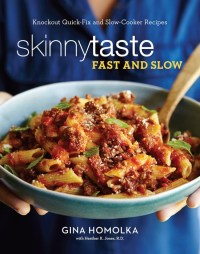 Of course, you can’t cook like Ina every night. She uses a lot of butter and cream, for one thing. One of my favorite cookbooks of the season is Skinnytaste Fast and Slow: Knockout Quick-Fix and Slow Cooker Recipes, by Gina Homolka. Half of the recipes can be prepared in 30 minutes or less, and half are designed for the slow cooker. Everything I’ve made has been easy, delicious, and healthy — I highly recommend the turkey-zucchini meatballs, which take four hours in the crockpot. Most slow cooker recipes take eight hours or more, but many of the recipes in this book take only a few hours, which is great if you want to throw your Sunday dinner in at 3:00 PM.

Forest Feast Gatherings: Simple Vegetarian Menus for Hosting Friends and Family, by Erin Gleeson, is a wonderful follow-up to the original Forest Feast, one of my most-used cookbooks. It’s also so pretty you’ll want to leave it on the kitchen counter. You can tell the author is a food photographer and stylist. The recipes are simple and wholesome as well as photo-worthy; our store manager, Max, made the roasted carrots and they look ready for Instagram.
 Jane Green’s Good Taste: Simple, Delicious Meals for Family and Friends is fun to cook from and just as fun to read. (Do you notice that cookbook subtitles frequently mention cooking for “family and friends”? Who else would you cook for? Strangers and enemies?) Like all my favorite cookbooks, it’s also an entertaining guide and has plenty of appealing photos. Green, who has written eighteen novels, includes amusing stories about cooking, herself, and her family, making Good Taste a great book to keep on your nightstand.
 In Home Cooking, Laurie Colwin says, “To feel safe and warm on a cold wet night, all you really need is soup” and “There is nothing like soup. It is by nature eccentric: no two are ever alike, unless of course you get your soup in a can.” Soup Nights: Satisfying Soups and Sides for Delicious Meals All Year, by longtime cooking teacher Betty Rosbottom, contains more than enough soup recipes to keep you safe and warm all winter. (Rosbottom also includes some cold soups for the warmer months.) The broccoli soup with creme fraiche is the best broccoli soup I’ve ever had, and takes only thirty minutes from start to finish. A friend of mine has a monthly Soup Night with her friends, which replaced their book club when no one could agree on which book to read. Every month, someone makes a big pot of soup and everyone brings a book to exchange. I think everyone in this group needs a copy of Soup Nights!
Actually, I think everyone needs a new cookbook this season. To quote Laurie Colwin once again:
Cookbooks hit you where you live. You want comfort; you want security; you want food; you want to not be hungry and not only do you want those basic things fixed you want it done in a really nice, gentle way that makes you feel loved. That’s a big desire, and cookbooks say to the person reading them, “If you will read me, you will be able to do this for yourself and for others.”
Happy Thanksgiving!
 Nonfiction: Generation Chef: Risking It All for a New American Dream by Karen Stabiner
 spite of the challenges presented by the legal and economic system in France.
 Michael Lewis has a new book coming out in December, The Undoing Project: A Friendship That Changed Our Minds, about two Israeli psychologists who did groundbreaking research on decision-making and judgment.
 Nonfiction: On Living by Kerry Egan
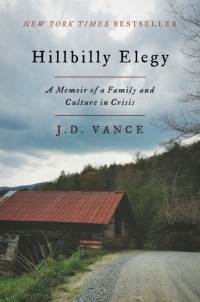 Nonfiction: Hillbilly Elegy: A Memoir of a Family and Culture in Crisis by J.D. Vance
 If we stop writing letters, who will keep our history or dare venture upon a biography? George Washington, Oscar Wilde, T.E. Lawrence, Virginia Woolf, Oliver Wendell Holmes, E.B. White, Vera Nabokov, J.P. Morgan — if any of these vivid predecessors still belong to us in some fragmented private way, it’s because of their letters or diaries (which are letters to ourselves) or thanks to some strong biography built on a ledge of letters.
 Mina Harker, one of Dracula’s victims, closes her letters by saying “Your ever-loving Mina Harker.” Frankenstein’s ill-fated fiancée, Elizabeth Lavenza, ends a letter with “Adieu! Take care of yourself, and I entreat you, write!”. What do these two characters have in common? They both appear in epistolary novels, books written either entirely or mostly in letters.
 Of course, sometimes only real letters will do. I treasure several anthologies of letters from both famous and ordinary people. War Letters: Extraordinary Correspondence from American Wars (edited by Andrew Carroll) and Letters of Note: An Eclectic Collection of Correspondence Deserving of a Wider Audience (edited by Shaun Usher). Volume 2 of Letters of Note just came out last month, and I’m savoring every letter. My all-time favorite epistolary book is Helene Hanff’s 84, Charing Cross Road (which, surprisingly, was made into a movie that does justice to the book), which chronicles a 20-year correspondence between Hanff, a writer in New York, and Frank Doel, an antiquarian bookseller in London. Another favorite is My Dearest Friend: Letters of Abigail and John Adams, which contains just a fraction of the 1,100 letters that the couple wrote to each other during the many separations they endured over the course of their 54-year marriage. Their letters bring the world of this country’s founders alive more than any other surviving documents.
 In a recent book called Signed, Sealed, Delivered: Celebrating the Joys of Letter Writing, Nina Sankovitch describes finding a trunk filled with hundreds of letters in a shed attached to a house her family was renovating in the Upper West Side of New York. The letters belonged to the original owners of the home, the Seligman family, and the vast majority of them were written by James Seligman to his parents (whom he addressed as “Dearest Mamma” or “Darling Parents”) during his years at Princeton, 1908-1912. Nina feels that rereading the letters James left behind “proves all over again, the power of the written, the handwritten, word.” Aside from a listing on an online family tree, James left no other evidence of his life. Nina says:
 Books on the Table