Maybe our favorite quotations say more about us than about the stories and people we’re quoting.
John GreenYou may want to keep a commonplace book which is a notebook where you can copy parts of books you think are in code, or take notes on a series of events you may have observed that are suspicious, unfortunate, or very dull. Keep your commonplace book in a safe place, such as underneath your bed, or at a nearby dairy.
Lemony Snicket
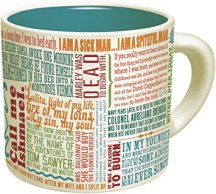
At the end of the year, how do I know which books were my favorites? All I have to do is go through my books to see which ones have the most dog-eared pages.
My third grade teacher, Mrs. Pierce, once reprimanded me for turning down the page of my book. She informed me that this was called “dog-earing” and it was very, very bad, on a par with wasting food at lunchtime and talking in the halls — two other crimes I had committed. Now I’m almost as old as Mrs. Pierce was then, and I can dog-ear my books anytime I want. If you borrow a book from me and there are lots of pages turned down, you know that this is a really good book filled with passages worth rereading and remembering.
One of my resolutions for 2017 is to transcribe my favorite quotes and passages into a notebook. I already do this with poems, and have found that the act of copying lines of poetry by hand helps me understand and remember them. I have a brand new “commonplace book” ready to fill, along with a box of my favorite Bic fine point roller pens. (I also plan to lose ten pounds . . . )
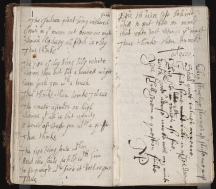
In high school, one of my favorite English teachers, Mr. Regan, told us that “quote” is a verb and “quotation” is a noun. Mr. Regan, the co-author of our textbook, the English Competence Handbook, devoted an entire chapter to the proper use of “Quotations”. To the chagrin of English teachers everywhere, the word “quote” has become commonly used as a noun. Even the people in charge of websites devoted to cataloging quotes seem confused. One website calls itself The Quote Garden (tagline: “I dig old books”) but lists quotations in hundreds of categories, from “curmudgeonesque” to “ladybugs”.
Ever since I left Mrs. Pierce’s classroom, I’ve dog-eared quite a few pages. Here are some of my favorite quotes (sorry, Mr. Regan!) from some of the best novels I read in 2016:
My teacher saw that I loved reading, and she gave me books, even grown-up books, and I read them. And then later in high school I still read books, when my homework was done, in the warm school. But the books brought me things. This is my point. They made me feel less alone.
Elizabeth Strout, My Name Is Lucy BartonAnd then he had come to think that what people needed, at bottom, was not only information but tales of the remote, the mysterious, dressed up as hard information. And he, like a runner, immobile in his smeared printing apron bringing it to them. Then the listeners would for a small space of time drift away into a healing place like curative waters.
Paulette Jiles, News of the WorldWhen all was said and done, the endeavors that most modern men saw as urgent (such as appointments with bankers and the catching of trains), probably could have waited, while those they deemed frivolous (such of cups of tea and friendly chats) had actually deserved their immediate attention.
Amor Towles, A Gentleman in Moscow
Books had never led me in the wrong direction. It seemed foolish to try to endure without such counsel by my side.
Affinity Konar, MischlingFranny on the other hand was just now opening the hardback copy of A Tree Grows inBrooklyn from her grandmother. Even from the first sentence, from the look of the words on the page, she could tell that was what she would be reading over Christmas vacation, not an LSAT prep book.
Ann Patchett, CommonwealthBesides, could children ever be considered quite of sound mind? Seven was counted the age of reason, but Lib’s sense of seven-year-olds was that they still brimmed over with imagination. Children lived to play. Of course they could be put to work, but in spare moments they took their games as seriously as lunatics did their delusions. Like small gods, children formed their miniature worlds out of clay, or even just words. To them, the truth was never simple.
Emma Donoghue, The Wonder
They had been raised, Charlotte and Beatrice, on books. When they had a question, literature answered it. If they complained about being bored, their mother — a melancholy Parisian who used laudanum to assuage the pains of homesickness and her husband’s infidelities — would hand them a book. “No one who reads can ever be bored,” she’d tell them . . .
Ann Hood, The Book That Matters MostForgiveness, they shouted, all the while committing their wrongs. When he was younger, Yaw wondered why they did not preach that the people should avoid wrongdoing altogether.
Yaa Gyasi, Homegoing
At times, I was so confused that I felt like the stem of a pinwheel surrounded by whir and clatter, but through that whole unsettling time I knew that it simply would not do to hide in the barn with a book and an apple and let events plunge forward without me.
Lauren Wolk, Wolf HollowWas that not the beauty of fiction, that it aimed closer at the bitter heart of truth than any biography could, that it could search out the spirit of those who may or may not have lived, and tell their story not as it unfolded, as a series of objective facts recorded by an indifferent world, but as they had lived it and, above all, felt it? Was there a finer way to honor friendship, and love, and being in the world?
Alison Anderson, The Summer GuestHer boxes and crates of books were stacked alongside, and Beatrice had to still a quiver of anxiety that she was to live, for the first time, in a place without a single bookshelf.
Helen Simonson, The Summer Before the War
His years on earth had taught him that good things happen to those who honor the kindheartedness of others.
Imbolo Mbue, Behold the DreamersI thought about how lives bump up against each other, whether for moments of superficial conversation in line at the post office or a deeper enmeshment, such as that I had with Jerry for those few months. How much meaning should I ascribe to knowing a stranger for the moments it took for me to donate to a V-book campaign? What are the evolutionary implications of kindness?
Elizabeth Church, The Atomic Weight of Love
Happy New Year! What are your reading resolutions for 2017?
 At a recent get-together, a (male) friend told me all about a great book he’d just read, prefacing his comments by saying, “I’m sure you haven’t read it.” The book? Blood and Thunder: The Epic Story of Kit Carson and the Conquest of the American West, by Hampton Sides, published about ten years ago. Obviously, he couldn’t imagine that Blood and Thunder would appeal to women, and he doesn’t know me well enough to know that I’ve loved books about the American West ever since I was a child, both fiction and nonfiction. (And yes, I have read Blood and Thunder. It’s great, as is anything by Hampton Sides; my favorite is In the Kingdom of Ice: The Grand and Terrible Polar Voyage of the USS Jeannette).
 The same evening, I got involved in a nostalgic conversation about favorite childhood books. When I mentioned The Little House on the Prairie series, someone said wistfully that she’d loved those books as a child but couldn’t share them with her children because she has only boys. I told her that I’d read the whole series — not just Farmer Boy — to one of my boys, and he’d enjoyed them almost as much as I did. “But they’re about girls!” she said. Well, no. They’re about people, and the settling of the American West. We give boys books featuring animals, aliens, and wizards, but we balk at suggesting they read about girls?
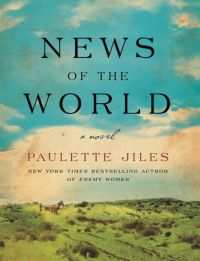 Several of my favorite books this year have been truly “unisex”. A Gentleman in Moscow, News of the World, When Breath Becomes Air, Salt to the Sea — all would appeal to almost any reader, male or female. Still, I need to oblige a friend who asked me to recommend books for men. I know she’s not alone in her quest to find books suitable for husbands, fathers, brothers, and sons — so here are some ideas for last-minute shoppers.
 Patient H.M.: A Story of Memory, Madness, and Family Secrets by Luke Dittrich
 Indestructible: One Man’s Rescue Mission That Changed the Course of WWII by John R. Bruning
 The North Water by Ian McGuire
 A few more manly suggestions:
 The booksellers at Lake Forest Book Store are not, on the surface, a diverse group. For one thing, we are all female. We are also all middle-aged, which is a horrible term, but one for which I can’t think of an appropriate euphemism. This doesn’t mean that we all like the same books. All of us are committed to reading widely, always mindful that our job is to recommend books to all kinds of readers. We have individual reading tastes, but we are all the same in that no one wants to squander time on a poorly written or boring book.
 Our buyer, Laura, said: “My favorite literary reads are The Nix (Nathan Hill), News of the World (Paulette Jiles), Mothering Sunday (Graham Swift) and Mischling (Affinity Konar). They are each so different (a sprawling contemporary story; a beautiful piece of historical fiction; a compact, compelling personal narrative and and a haunting World War II novel). My favorite heartwarming, simply lovely book is A Gentleman in Moscow (Amor Towles).” (Mine too!)
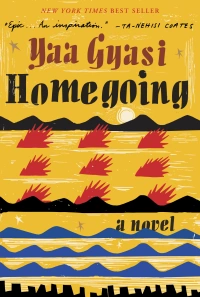 Diane commented that “This was such a strong year for fiction! I read so many fantastic books– these are not in a particular order but two of them may be in my top-ten lifetime list. For all of them, the characters were so strong and the writing drove these books even more than plot/pace: Homegoing (Yaa Gyasi) Behold the Dreamers (Imbolo Mbue), The Mothers (Brit Bennett), News of the World, Wolf Hollow. Diane and I lead a YA book group for adults, and Wolf Hollow was one of our group’s favorites.
 Eleanor chose Lilac Girls, Martha Hall Kelly’s debut novel, which I adored as well. Anyone who loved The Nightingale, Salt to the Sea, The Invisible Bridge, or All the Light We Cannot See will find this book both unforgettable and hard to put down. Historical fiction at its best, the novel tells the powerful story of female prisoners subjected to medical experimentation at the hands of the Nazis.
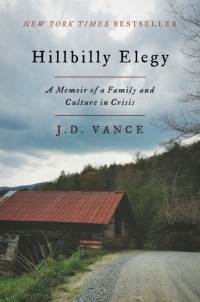 Susan P.’s pick was Hillbilly Elegy: A Memoir of a Family and Culture in Crisis, by J.D. Vance: “It is the poignant, inspiring, and eminently readable story of a young man overcoming the many drawbacks and disadvantages of his youth. Incisive and articulate, a very thoughtful examination of the issues of systemic poverty.”

 Books on the Table