In occupied Germany, the refrain “We didn’t know” was becoming as common as “Ich bin kein Nazi” (I am no Nazi). The Germany Manny had left when his mother put him on a train as a fourteen-year-old to join other Jewish refugee children on a ship to America had lots of flag-waving Nazis. Now that the Thousand Year Reich had fallen, where had they all gone?
Bruce Henderson, Sons and Soldiers, describing the wartime experiences of Manfred Steinfeld, 82nd Airborne Division
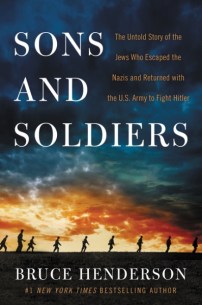 The subtitle of Bruce Henderson’s Sons and Soldiers is The Untold Story of the Jews Who Escaped the Nazis and Returned with the U.S. Army to Fight Hitler. (Is it my imagination, or are the subtitles of nonfiction books keep getting longer and longer?) This workmanlike subtitle not only summarizes the book, but tells readers two things about Sons and Soldiers: 1) It’s one of a seemingly endless stream of books about fascinating but little-known aspects of World War II; and 2) The writing will be competent but not brilliant.
I will read almost anything about World War II, and I’m particularly drawn to relatively undiscovered stories, nonfiction and fiction. Sons and Soldiers, which tells the story of more than 2,000 German-born Jews who escaped Nazi Germany and joined the United States Army as military intelligence specialists, is exactly the kind of book that appeals to me. While It didn’t disappoint me –I found the stories of these extraordinarily brave men compelling and inspiring — Sons and Soldiers is not one of the best World War II books I’ve read. Henderson did an amazing amount of research on the Ritchie Boys, working with a team of researchers for two years to uncover their stories, and interviewing many veterans. Although he says, “Narrative nonfiction starts and ends with rigorous research, which allows an author to be meticulously selective in using only the material that adds to the impact of the story,” I thought he sometimes included too many details. I could have done without some of the long descriptions of battle scenes; I just wanted to know what the Ritchie Boys were doing.
What interested me most in the book were the stories of each of the Ritchie Boys that Henderson follows through the war years — their childhoods in Germany, their journeys to America, their wartime heroism, and the eventual fates of their families. I was captivated by Henderson’s account of the unorthodox interrogation technique that Werner Angress used during the Battle of the Bulge on a tough, battle-hardened German sergeant who, unlike most of his peers, refused to supply any information other than his name, rank, and serial number:
Werner shrugged and sat back . . . he inquired in German just how such an experienced old bird like him was taken prisoner by a bunch of green young Yankees. Offended, the prisoner began to stutter in response, then exploded in indignation. As the sergeant spewed an angry torrent of words, Werner interrupted with brief technical questions, all of which were promptly answered before the sergeant continued his diatribe. In this way, Werner soon knew the identity and strength of the sergeant’s unit, the names of his commanders, and other information . . . where the sergeant’s regimental headquarters were located, where their machine guns were placed, and even where the German soldiers lined up to get their chow.
After the war, the Army estimated that more than sixty percent of the credible intelligence gathered in Europe came from the Ritchie Boys. Their interrogation techniques relied not on bullying and intimidation, but on understanding the culture and psychology of the men they were interrogating.
The narrative isn’t linear, but jumps around as Henderson focuses on various Ritchie Boys — each of whom has a more incredible story than the next. I was sometimes confused, since one of the main characters would appear on one page and disappear for several chapters, only to show up in a different time and place. For example, the book opens with the arrest and deportation to Dachau of twelve-year-old Martin Selling. A couple of chapters later, he is released from Dachau and manages to obtain an exit visa from Germany. In the intervening chapters, we’re introduced to several other young German Jews whose families are trying desperately to get them out of the country, so when Martin reappears, most readers will find themselves flipping back to the beginning to reacquaint themselves with his story.
Despite my occasional frustration with the flow of the book, I couldn’t stop reading it. The courage these men displayed is almost unbelievable. As boys, they left their families behind, not knowing if they would ever see them again, and as young men, they risked their lives repeatedly, often turning down relatively safe assignments for dangerous missions. They all knew if they were captured by the Germans they wouldn’t be treated as American prisoners of war, but would be executed as Jews.
Stephan Lewy, one of the Ritchie Boys profiled in Sons and Soldiers, has spoken to more than 20,000 schoolchildren since he retired in 1991. One child asked him, “Are you like a cat with nine lives?” — a question that could reasonably be asked to any of the Ritchie Boys. Lewy, now ninety-one years old, has found it therapeutic to share his story, saying:
When I look into their faces as they listen to my story, I have hope that I can make a difference. My story shows what can happen if people do not act. Perhaps if enough people hear these stories, history will not repeat itself. I only hope the world has learned a lesson.
 Albrecht had not approved at first. Assassination. Murder. It was not the culmination he wanted for the resistance movement. In his estimation, injustice could be fought only with justice — he was a lawyer to the core. Murder was evil. This was an absolute. But if it would end the war and prevent the murder of thousands? Even millions? They had debated this often deep into the night with him probing his own convictions and Marianne playing devil’s advocate. Although in fact, she was not the devil’s advocate. She believed Connie and von Stauffenberg and the others were right. Hitler must be killed.
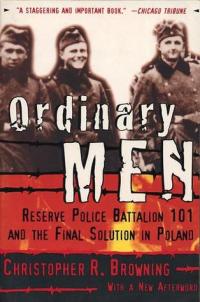 Shattuck says that although “The Women in the Castle centers on three widows of resisters, it is as much a book about complicity as it is one about resistance.” Franz Muller, with whom Benita falls in love, is tortured by his complicity in atrocities. I wasn’t surprised to read in Shattuck’s Acknowledgments that Ordinary Men: Reserve Police Battalion 101 and the Final Solution in Poland by Christopher R. Browning was one of her sources. One of the most powerful and thought-provoking books I’ve ever read, Ordinary Men describes how a group of middle-aged men willingly murdered thousands of innocent Jews, even though they would suffer no negative repercussions if they refused to participate.

 I loved Lisa See’s breakout novel, Snow Flower and the Secret Fan, but didn’t think her subsequent books were quite as good. The Tea Girl of Hummingbird Lane is on a par with Snow Flower. The story, centered on a Chinese peasant woman and the daughter she’s forced to abandon, who is adopted by an American family, is terrific — and the novel is packed with interesting information about Chinese hill tribes and the tea industry. When I started the book I assumed it was set in the past, and was shocked when I realized the tribal culture See describes so well has only recently faded away as modernization has entered the most remote areas of China. (By the way, On Gold Mountain, the chronicle of the See family’s history in the United States, reads like a novel and might be my favorite of all See’s books.)
 Jessica Shattuck’s debut novel, The Women in the Castle, has received a lot of pre-publication hype — deservedly so. If you think you’ve read more than your share of World War II novels, think again, because The Women in the Castle provides a fascinating perspective unfamiliar to most readers. The “women” of the title are the widows of three conspirators who plotted to assassinate Hitler. I’ll post a full review on April 20.
 I’d like to recommend a smaller novel you may not have heard about — The Devil and Webster by Jean Hanff Korelitz. (For those who are wondering, the author is a cousin of Helene Hanff, author of 84 Charing Cross Road.) I read this book almost without stopping, and when I reached the very satisfying ending, I actually wished the book were longer. Often, when I finish a book, I think, Didn’t anyone edit this book? I could have cut out a third of it.
 This is a girl who has lived through broken dreams and promises. Still lives. Will always live on that hillside, at the center of a world that unfolds all the way to the edges of the canvas.
 Over the years, the artist and his subject develop a close and trusting relationship. Christina, a bitter woman whose life has brought her many disappointments, is difficult for most people to like. She rejects the kind, if awkward, attempts of neighbors to befriend and help her. But she and Andy are kindred spirits, in a way:
 When Christina first meets Andrew Wyeth, he’s introduced as N.C. Wyeth’s son: “‘You know N.C. Wyeth. The famous illustrator? Treasure Island?'” Robert Louis Stevenson’s classic adventure novel stands in contrast to the story of Christina’s life, in which a trip to Boston is an exciting experience. Al, who longed to make a living on the sea and whose forebears traveled the world on sailing ships, read Treasure Island a dozen times — “Might be the only book I ever actually finished, now that I think about it,” he says.
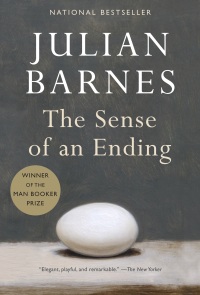 The Sense of an Ending by Julian Barnes (163 pages)
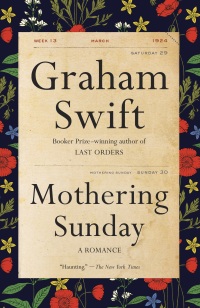 Mothering Sunday by Graham Swift (177 pages)
 Last Night at the Lobster by Stewart O’Nan (146 pages)
 Another Brooklyn by Jacqueline Woodson (170 pages)
 I urge you to get to your leanest livable weight and then, whatever it is, decide that it’s okay. Because your weight is not the point. You were not put on this earth to mold yourself into a perfect physical specimen.
 The table is a meeting place, a gathering ground, the source of sustenance and nourishment, festivity, safety, and satisfaction. A person cooking is a person giving; even the simplest food is a gift.
 You know a cookbook is more than a cookbook when it merits a full-length review in the Atlantic. An article entitled
 Of course, you can’t cook like Ina every night. She uses a lot of butter and cream, for one thing. One of my favorite cookbooks of the season is Skinnytaste Fast and Slow: Knockout Quick-Fix and Slow Cooker Recipes, by Gina Homolka. Half of the recipes can be prepared in 30 minutes or less, and half are designed for the slow cooker. Everything I’ve made has been easy, delicious, and healthy — I highly recommend the turkey-zucchini meatballs, which take four hours in the crockpot. Most slow cooker recipes take eight hours or more, but many of the recipes in this book take only a few hours, which is great if you want to throw your Sunday dinner in at 3:00 PM.
 Jane Green’s Good Taste: Simple, Delicious Meals for Family and Friends is fun to cook from and just as fun to read. (Do you notice that cookbook subtitles frequently mention cooking for “family and friends”? Who else would you cook for? Strangers and enemies?) Like all my favorite cookbooks, it’s also an entertaining guide and has plenty of appealing photos. Green, who has written eighteen novels, includes amusing stories about cooking, herself, and her family, making Good Taste a great book to keep on your nightstand.
 In Home Cooking, Laurie Colwin says, “To feel safe and warm on a cold wet night, all you really need is soup” and “There is nothing like soup. It is by nature eccentric: no two are ever alike, unless of course you get your soup in a can.” Soup Nights: Satisfying Soups and Sides for Delicious Meals All Year, by longtime cooking teacher Betty Rosbottom, contains more than enough soup recipes to keep you safe and warm all winter. (Rosbottom also includes some cold soups for the warmer months.) The broccoli soup with creme fraiche is the best broccoli soup I’ve ever had, and takes only thirty minutes from start to finish. A friend of mine has a monthly Soup Night with her friends, which replaced their book club when no one could agree on which book to read. Every month, someone makes a big pot of soup and everyone brings a book to exchange. I think everyone in this group needs a copy of Soup Nights!
 Nonfiction: Generation Chef: Risking It All for a New American Dream by Karen Stabiner
 spite of the challenges presented by the legal and economic system in France.
 Michael Lewis has a new book coming out in December, The Undoing Project: A Friendship That Changed Our Minds, about two Israeli psychologists who did groundbreaking research on decision-making and judgment.
 Nonfiction: On Living by Kerry Egan
 Nonfiction: Hillbilly Elegy: A Memoir of a Family and Culture in Crisis by J.D. Vance
 The Mare by Mary Gaitskill
 This Was Not the Plan by Cristina Alger
 My Name is Lucy Barton by Elizabeth Strout
 The Expatriates by Janice Y.K. Lee
 Clementine: The Life of Mrs. Winston Churchill by Sonia Purnell
 Joy and liveliness had come back to his readings now. His voice had its old vibrancy again, and he smiled as he read the amusing things, the Hindi women who would not say their husbands’ names, odd telegraph messages caught by a reporter, and recalled how dull his life had seemed before he had come upon her in Wichita Falls. He saw her bright, fierce little face break into laughter when the crowd laughed. It was good. Laughter is good for the soul and all your interior works.
 Books on the Table