Girl Through Glass –Author Interview

Girl Through Glass coverDancers are just flowers, and flowers grow without any literal meaning, they are just beautiful. We’re like flowers. A flower doesn’t tell you a story. It’s in itself a beautiful thing.
George Balanchine

The other girls, and their imperfections, fade away as Mira runs ahead on a stream of energy and light. Her body tells her what to do and she just goes along with it . . . Something great is growing in her, unrolling its tendrils, sprouting buds in all directions. Sometimes the song in her body is almost too loud; it fills her eyes, makes them tear up in something like gratitude.
Sari Wilson, Girl Through Glass

The first thing you need to know about Sari Wilson’s debut novel, Girl Through Glass, is that it’s much more than a “ballet book”. Like every memorable book, it transcends its surface subject matter and explores universal themes; in this case, art, obsession, sexuality, and family relationships. “I really wanted to write a book that wasn’t just about ballet,” Wilson said at an event at the Book Stall in Winnetka, Illinois. “The idioms and milieu of ballet make for compelling human drama.”

The world of ballet in late 20th century New York provides a fascinating backdrop for the novel’s two narratives. Mira is a young girl with a difficult family life who finds refuge in the art and discipline of ballet. Kate is an ex-dancer and college dance history professor who can’t seem to move forward and is forced to revisit her buried past. For both, George Balanchine’s ideal of feminine beauty looms large. “Ballet is woman,” Balanchine famously said. The subject of Kate’s Ph.D. dissertation was “Corporeality Subverted: The (Dis)embodied Feminine in the Aesthetic of George Balanchine, 1958-1982”.

b7160f981f4922d5ab7bf9eababa9085Doesn’t almost every little girl dream of becoming a ballerina? My dream died quickly, after several months of patient instruction from Mrs. Goneconto at the local YMCA. I was disappointed to learn at the first class that I was not immediately issued a tutu and toe shoes, and things went downhill from there. Mira and her fellow “bunheads” exist on a different level, pushing themselves to their physical and emotional limits in what Wilson calls “pure devotion to an ideal”.

Wilson, whose own dance career was cut short by an injury, called herself a “recovering ballerina” in a recent New York Times piece, “My Nutcracker Recovery”. When her daughter is cast in a production of “The Nutcracker”, Wilson has mixed feelings — but as she watches her little girl rehearse, Wilson remembers her childhood passion for dance: “My own early swooning love for ballet — for the pure motion and expression of dance — floods back to me, confusing, powerful, bittersweet, and it finds me a little bit healed.”

Girl Through Glass is at its heart a coming of age story, focusing on a girl and a woman at inflection points in their lives. Wilson spent years crafting the novel, which was a creative endeavor, she points out, not unlike choreographing a dance.

How would you compare the art of writing to the art of dance?

In a lot of ways they seem inverse: dance is an art that is performance-based, completely dependent on the body as instrument for communication; writing is a cerebral art and employs written language as an instrument for art. But underneath, they share a lot: the need for discipline, repetition, and a strong desire to communicate. In the age-old days, dance and poetry were integrated, I think, but they split off from each other and became their own disciplines. But in their roots, they are very related.

Like many fiction writers, you started out by writing short stories. You mentioned that Girl Through Glass had its origins in a short story about a young ballet dancer. How would you compare the process of writing short stories with the process of writing a novel?

Writing short stories is sustainable in sprints, whereas writing novels is a marathon undertaking. For me, the novel demanded a wider range of skills—analytic and associative. Novels are aptly named—each adheres to its own rules, its own logic, they are very elastic. I enjoy the form because it can accommodate multiple dialectics and tensions.

Have you made any particular effort to connect with the ballet community? How do you think members of that community will view the novel?

One of the things that I have been really gratified about is that the ballet community has been so accepting of the novel. I have had dancers and former dancers and “recovering” dancers (my term) tell me that the novel describes their own experience. It’s not a glowing portrait of the ballet world, but it is a one told with love and passion—maybe the passion of a child who can love and be hurt deeply. I think dancers understand that the novel is full of admiration for what they do, as well as what the costs can be.

You very deftly weave the two narratives — Mira’s and Kate’s — together. Was one of them more difficult to write than the other? Did you know where the story was going when you began?

I actually didn’t know where the story was going. I first wrote Mira’s storyline. When I had finished, I realized that the novel wasn’t complete—around the same time, I started writing from this other voice, a 1st person voice, a much older voice, a bit bitter, even angry. I didn’t know who it was at the time. As I wrote her story I realized who she was and how she was connected to Mira. I realized I could use Kate’s story as a frame for ordering Mira’s story; it was only then that I felt I had a book, a novel.

You paint a vivid and accurate picture of 1970s New York City. New York has changed a great deal in the past few decades. What, if anything, has been lost? 

It’s trendy, I guess, to be nostalgic for 1970s New York, but for me it is very specific nostalgia: the nostalgia of the world through a child’s eyes that has been transformed. So it’s a journey into personal memory of a lost childhood world, a New York City of the past—a very frayed urban landscape. But what has been lost? Well, there is a great Edmund White piece about this in The New York Times ; in it he basically says it has to do with the economy and real estate. What is largely lost is the sense of freedom to fail abundantly that the city allowed people at that time—that ecosystem benefited creativity and allowed a certain kind of romanticism around art-making, but at the cost of safety.

How has ballet changed since MIra’s and Kate’s years as young dancers?

Mira’s era was a very specific era, when Balanchine aesthetic was at its very height. I think the playing field is much wider now—there are so many more different types of companies with modern and ballet cross-over. And the conversation about body image and race that is happening around Misty Copeland’s terrific rise is all very exciting and overdue.

Kate finds that the world of academia is, in its own way, as cutthroat and competitive as the world of dance. Can you comment on that?

Yes, that actually surprised me. I’m not in academia, but as I did my research I came to realize that there was an incredible amount of cutthroat competition in that world—especially at Kate’s level. Kate has made it into a pool of very talented and ambitious candidates for which there are not enough permanent positions, which makes her situation very tenuous. Not unlike the hierarchies of the dance world, in which there are very few coveted spots for soloists and principals.

Sari Wilson AP Photo credit Elena SeibertFor generations, little girls have dreamed of becoming ballerinas — and some of them have suffered, physically and emotionally, as they’ve pursued their ambitions. Certain parents (and not just ballet parents) are willing to sacrifice and also to let their children experience physical and emotional harm in the hopes of raising superstars. Adults, like Maurice, can become obsessed with the beauty of ballet. What is it about ballet that inspires such passion?

Maybe it is the kind of innocence that it requires, a kind of passionate innocence and a ungovernable belief in beauty (in the broader Romantic sense, Beauty as in Truth)? There probably will always be something captivating about noble suffering in pursuit of some truth? So much art is about this theme. Ballet displays it in the vernacular of the body and in a kind of nobility of form that can be as hypnotizing as well as destructive. It can contain, I suppose, our best and worst impulses as humans. It holds a mirror up to our inner selves, perhaps.

Thank you, Sari, for answering my questions so thoroughly and thoughtfully!

Book Club Spotlight — Celebrity Book Clubs


41cpynrrvxl-_ac_ul320_sr210320_
The first selection of Oprah’s book club

It all started with Oprah Winfrey. In 1996, she launched a book club that made an enormous impact on readers, authors, and publishers. For 15 years, Oprah’s choices became worldwide bestsellers. During the heyday of her club,  Oprah’s power as a recommender, often called the “Oprah Effect” in the publishing world, was unparalleled. Michael Pietsch, currently CEO of Hachette Book Group and past publisher of Little, Brown & Co., said in a USA Today article that Oprah “didn’t originate the idea of book clubs, but more than anyone, she has spread the idea of reading a book as a shared community.” Nora Rawlinson, who’s been the editor of Library Journal, Publishers Weekly, and now EarlyWord, citing surveys showing that “friends’ recommendations are the top reasons people buy a book” says that “Oprah is the ultimate friend to her audience.”

A lot of readers must think they’re friends with actress Emma Watson, because as of today, 84,000 people had signed up for her new feminist book club, “Our Shared Shelf”. Watson, who became famous through her portrayal of brave and brilliant  Hermione in the Harry Potter movies, is a United Nations Women Goodwill Ambassador with a special interest in gender equality and its benefits for both men and women. UN Goodwill Ambassadors are celebrity advocates, drawn from the “worlds of art, music, film, sport and literature to highlight key issues.”

Watson has ambitious plans for her book club. In her announcement on Goodreads, she says:

The plan is to select and read a book every month, then discuss the work during the month’s last week (to give everyone time to read it!). I will post some questions/quotes to get things started, but I would love for this to grow into an open discussion with and between you all. Whenever possible I hope to have the author, or another prominent voice on the subject, join the conversation.

9780679456209Watson has selected Gloria Steinem’s memoir, My Life on the Road, for the first online discussion, scheduled to begin in  a couple of weeks. (The exact date isn’t clear.) I’m not sure how the logistics of an online discussion with thousands of people will work, but kudos to Emma Watson for launching the club on January 6, choosing the first book on January 8, and attracting 84,000 enthusiastic participants less than a week later. I’m just glad I don’t have to supply the wine and cheese.

Mark Zuckerberg made a reading resolution last year, announcing on January 2, 2015 that he planned to read a book every other week and post discussions on Facebook. His Facebook page for “A Year of Books” says: “We will read a new book every two weeks and discuss it here. Our books will emphasize learning about new cultures, beliefs, histories and technologies.” As of December 28, the “community” (Zuckerberg never refers to it as a “book club”) had read 23 books, just short of the stated goal of 26 books. Many recent commenters wondered if “A Year of Books” would continue in 2016; one commenter replied, “I believe that Mark has a new challenge for 2016”. He does — and it doesn’t involve books. Zuckerberg posted this update on Facebook:

Every year, I take on a personal challenge to learn new things and grow outside my work at Facebook. My challenges in recent years have been to read two books every month, learn Mandarin and meet a new person every day. My personal challenge for 2016 is to build a simple AI to run my home and help me with my work.

On Immunity.JPGI guess that building a robot would take away from my reading time, so I’ll stick with books. Zuckerberg’s reading list, with a few exceptions, looks pretty dreary to me — I’m not reading The Structure of Scientific Revolutions (a history of science published in 1970) anytime soon. Maybe Zuckerberg got burned out on reading because he didn’t include any fiction in the mix, except a work of science translated from the Chinese (The Three-Body Problem) whose title refers to the “three-body problem in orbital mechanics.” I did enjoy, and highly recommend, one of Zuckerberg’s picks — On Immunity: An Inoculation, by Eula Biss. This fascinating book, which defies categorization (science? sociology? memoir?) would be a great choice for real-life book clubs.
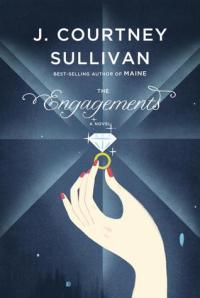
16071736Vogue magazine calls actress and producer Reese Witherspoon the “new patron saint of literature”.  Witherspoon’s production company, Pacific Standard, produced film adaptations of Cheryl Strayed’s Wild and Gillian Flynn’s Gone Girl; current projects include movie versions of The Engagements (J. Courtney Sullivan) and Luckiest Girl Alive (Jessica Knoll) and a TV miniseries based on Big Little Lies (Liane Moriarty). According to Vogue:

As if bringing these stories to the big screen weren’t enough, Witherspoon constantly promotes the many books on her nightstand on her Instagram account. Her posts, which have included snaps of Lena Dunham’s Not That Kind of Girl, Malala Yousafzai’s memoir, and many others, have become the equivalent of an Oprah’s Book Club stamp for the social media generation.

I’ve come across many references to Reese Witherspoon’s “book club”, but all I could find was her Instagram feed with photos of book she’s reading followed by thousands of brief comments from her adoring fans — “She always reads awesome books!”; “Follow Reese for book recommendations!”; “Have to get this one!” This seems like a far cry from Oprah’s hour-long, in-depth televised interviews with authors. But more power to Witherspoon for getting on her celebrity soapbox to support books she loves. The cynic in me needs to add that some of these are books she’s bought the film rights to — so not only does she love them, she has a financial stake in their success.

rosie-project-9781476729091_lgBill Gates doesn’t have a book club, but he frequently posts reviews on his blog, Gates Notes. He told the New York Times he reads about 50 books a year, mostly nonfiction with a few novels interspersed. He’s a book blogger after my own heart, telling the Times that “he rarely posts negative reviews of books, explaining that he sees no need to waste anyone’s time telling them why they shouldn’t bother reading something.” He recommends one of his fellow billionaire Mark Zuckerberg’s choices, On Immunity:  “When I stumbled across the book on the Internet, I thought it might be a worthwhile read. I had no idea what a pleasure reading it would be. ” Gates also enjoyed Graeme Stimson’s The Rosie Project, a charming novel about a professor on the autism spectrum trying to find love: “It’s an extraordinarily clever, funny, and moving book about being comfortable with who you are and what you’re good at. I’m sending copies to several friends . . . This is one of the most profound novels I’ve read in a long time.”

Do celebrities influence your book choices? And what do you think of online book clubs in general?

The Santa Claus Man — Book Review

image001-199x300 copySo Gluck stretched the truth in the service of Santa Claus. Sometimes one had to take liberties with facts in order to get, and keep, people’s attention, he reasoned. What was Santa Claus if not a friendly deception invented to delight and encourage better behavior?
One Christmas Eve, journalist Alex Palmer discovered that his great-great-uncle, John Duval Gluck, Jr.,  was the founder of New York’s Santa Claus Association. For 15 years during the early 20th century, this charitable organization was responsible for fulfilling the wishes of thousands of New York children who sent letters to the North Pole. Palmer was dismayed to learn that Gluck wasn’t so much a philanthropist as he was a huckster, who lined his pockets with money from generous and trusting donors.

Palmer’s exhaustively researched book, The Santa Claus Man: The Rise and Fall of a Jazz Age Con Man and the Invention of Christmas in New York, is — as the title indicates — about more than Gluck’s nefarious activities.  The book includes two linked narratives: a sympathetic  and comprehensive chronicle of Gluck’s life and personality, showing the complex motivations for his self-aggrandizing and often dishonest activities, and an equally detailed account of the transformation of Christmas from a religious holiday into a cultural and commercial event.

A self-described “secret history sleuth”, Palmer is the author of two previous books,  Weird-O-Pedia: The Ultimate Collection of Surprising, Strange, and Incredibly Bizarre Facs About (Supposedly) Ordinary Things and Literary Miscellany: Everything You Always Wanted to Know About Literature. For a writer oriented towards the quirky side of life, delving into the obscure story of New York’s “Santa Claus man” and his world was a fascinating project. Palmer’s research led him to previously unknown relatives. He says:

My search to uncover the true story of John Gluck took me to Georgia, Florida, Texas, and into hidden pockets of New York City. I spoke to relatives I hadn’t known existed and was lucky enough to meet them. My first big break came with I tracked down a distant cousin of mine . . . She recalled John fondly and offhandedly mentioned she may have some of his papers in storage somewhere. In fact, she discovered she had several storage boxes full of his stuff . . . a trove of John’s personal correspondence, official Santa Claus Association documents, and original Santa letters that served as the backbone of The Santa Claus Man.

Palmer also uncovered an FBI report on Gluck’s deceptive activities, documents about Supreme Court case Gluck fought against the Boy Scouts of America, and “lots more Santa letters”.  Palmer says his investigation “revealed a man who yearned for escape from a mundane life, but lost his bearings once he broke free.” The book includes nearly 40 pages of endnotes and a bibliography, attesting to Palmer’s thorough exploration of his subject. (It also contains dozens of terrific vintage photos, including a sketch of Gluck’s proposed Santa Claus Building, intended to “blend spiritual ideals and consumerism into a true ‘Cathedral of Commerce'”.)

Sometimes Palmer’s enthusiasm for trivia overwhelms the reader, detracting from the narrative. It probably isn’t necessary to know, for example, that the nation’s first airmail delivery took place on September 23, 1911 in a Bieriot XI monoplane and included a sack of 640 letters and 1,280 postcards.

Palmer successfully places Gluck’s story in historical context. Publishers Weekly comments that:

Palmer deftly weaves in other cultural touchstones such as the genesis of the Boy Scouts, Clement Clarke Moore’s “A Visit from St. Nicholas,” and the WWI Christmas Day armistice (in which opposing armies traded goods) to tell the larger story of America’s adoption and adaptation of Christmas that endures to this day.

The Boy Scouts are, in fact, integral to the story. In 1910, two Boy Scout organizations were formed in the United States: the Boy Scouts of America and the American Boy Scout (no “s”, peculiarly — and later to become the United States Boy Scout.) The groups differed in one significant way: members of the American Boy Scout carried guns. Many parents didn’t want their Boy Scouts armed, especially after one 12-year-old American Boy Scout shot and killed a 9-year-old boy. The “chief scout” of the American Boy Scout organization didn’t think that banning guns from his organization was the best way to ensure the group’s survival — instead, he decided, they would volunteer to help the Santa Claus Man.

If you’re looking for a sweet Christmas story, The Santa Claus Man probably isn’t what you have in mind — but history and true crime buffs will enjoy this offbeat tale of greed and good intentions.

A Conversation with Rebecca Makkai

512bpnaxg3rl-_sy344_bo1204203200_“We’re living in this terrible world with wars and broken hearts and starvation, but some of us are compelled to make art, like that’s supposed to help anything.”

The narrator in Rebecca Makkai’s short story, “Peter Torelli, Falling Apart”

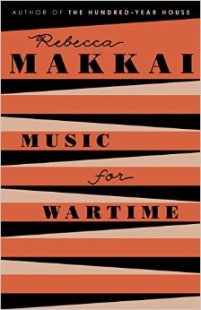
Rebecca Makkai’s short story collection, Music for Wartime, was originally scheduled for publication on July 14, 2015 — the same day, her publisher learned, that Go Set a Watchman would hit the shelves. Short story collections, regardless of their literary merit, have a tough enough time attracting  readers’ attention without competing with the year’s most talked-about book. So Music for Wartime came out on June 23, and Makkai’s job as a salesperson for her book — which was 13 years in the making — began.

Makkai, the author of two acclaimed novels (The Borrower and The Hundred-Year House), is one of today’s most accomplished writers of short fiction. The Kansas City Star says: “If any short story writer can be considered a rock star of the genre, it’s Rebecca Makkai. She has had a story selected for the annual Best American Short Stories anthology in four consecutive years.” Music for Wartime includes those four stories, along with 13 others. Divergent in tone, style, and subject matter, the stories all address the same question — “what it means to be an artist in a brutal world,” as Makkai put it.

Rock stars don’t have any trouble filling arenas with screaming fans. Literary stars, on the other hand, are relieved when a bookstore has to set up extra chairs to accommodate readers who have come to hear a favorite author. Makkai’s appearance last week at Lake Forest Book Store (her hometown store) was her last bookstore event promoting Music for Wartime. On Thanksgiving, I’m sure she’ll be feeling gratitude that she can now turn her full attention to writing! She graciously took time out from a residency at Ragdale (a writers’ retreat), where she is working on her third novel, to discuss her short story collection.

10738849Here are some edited highlights of my 45-minute conversation with Rebecca Makkai.

I though we could start out by talking about short stories in general. I have to say, having been a bookseller for a long time, short stories can be a hard sell. I absolutely love them — I’ve always loved them. But the minute you tell a customer about a book of short stories, you can see the look on their face — “Oh no, not short stories!”

They always get critically recognized — it’s a matter of the commercial sales. My first experience a couple of years ago — which is proof of this — was when I was working on Small Business Saturday. Sherman Alexie started this initiative to get authors in bookstores the Saturday after Thanksgiving, to handsell books. I’ve done it here, and last year I did it at City Lit in Logan Square, and this year I’m going to Women and Children First down in the city.  I started to realize, selling here and selling in Logan Square, that I could not move a story collection to save my life.

You should have gotten a bonus if you did.

There was one guy, who came in shopping for his girlfriend who wanted to be a writer. That was the one person, who bought three story collections.

You’ll notice, they didn’t put “stories” on the cover (of Music for Wartime) — sneaky move!

I think part of the reason is there’s no hook for people the way there is with a novel. If someone wants to pitch a book to their book club, if it’s a novel, they can say “It’s the story of a woman who buys a bookstore, and this happens to her, and this happens to her”, and people get involved, and they want to hear more about it. With a story collection, you can’t pitch the plot that way.

And I have to add — tonight is the National Book Awards, and good news for the short story: two collections are on the short list: Adam Johnson’s Fortune Smiles and Karen Bender’s Refund.

And last year, the one that won was a book of short stories — Redeployment, by Phil Klay.

You always hear about how people’s attention spans are shorter today, in the Internet Age . . . you can read a story in 15 minutes, versus investing all that time in a novel.

I don’t think that’s true. Look at what people watch on TV. The age of the little 30-minute sitcom is over. People want epics. They want to binge-watch seven hour-long episodes of something. I get it, I write novels too. But I feel that people are missing out if they don’t read short stories. They’re missing out on what can be done — the avant-garde of literature.

You can take so many more risks with a short story.

Yes, think of something like Kafka’s “The Metamorphosis”. You cannot maintain that for 300 pages. No one wants to read a 300-page novel about a cockroach. But you can do it for 15 pages. You can be experimental with form, with language in a short story in a way that would be unsustainable or unbearable in a 300-page novel. So when people miss that, they’re missing, I think, what literature can do.

I’ve made my peace with it because every year I watch the Oscars, and when they start with the awards for short films, I go make popcorn.

Getting back to Kafka, you have a couple of stories that sort of remind me of his. This collection is so great because of that — the stories are all different in terms of tone, subject matter, and style. There’s magical realism, there’s humor, there are family legends — there’s so much variety here, but there’s something binding them all together. Every story is about somebody who’s creating something. Can you talk about how you assembled this group of stories and how you chose which ones to include?

Part of the reason this wasn’t my first book  and that I focused on my novels first is that I couldn’t understand how to put the stories I’d written into a collection. I feel like a story collection should be more than just a pile of stories and more than just a sum of its parts — it should be like an album, that adds up to something more.

Very early on, before I’d published my first novel, I sent out a really incomplete collection — someone had gotten me an introduction to a publisher — and they very wisely passed on the collection, because it didn’t come together at all. But the editor who wrote back took the time to say, “I could see these stories eventually coalescing around a theme. I notice the themes of both music and war are really prominent in these stories.” I was thinking about that letter years later, and the title, Music for Wartime, came to me. I liked that it sounded like an album, like an old LP of World War I songs.

The idea that those themes could coexist, and the themes I was already writing about, the stories I was already writing about artists and music, and the stories I was already writing about refugees and dissidents and interrogations and war, that they were really speaking to the same question. I think of it as a question rather than a theme, the question being, “What does it mean to try to make beauty, to make art or order in the midst of a brutal and chaotic world?”

auth-ph-13-cropped-jpeg1-300x400There are some stories interspersed that are almost like memoir snippets — I assume they’re fictionalized family history?

Overtly fictionalized nonfiction . . . It’s already  in many ways a collection about the line between fiction and reality — there’s a story about a reality TV show, for instance. So it felt right that these stories went in there — I was taking the story I’d been told, acknowledging that I don’t really know what happened, and then working with my uncertainty to create a piece of fiction. But it’s very clear that that’s what I’m doing, rather than passing them off as fiction, or passing them off as nonfiction, kind of laying bare the process a little bit.

Can you share a little about your family history? 

My father was a refugee in 1956 following the failed Hungarian revolution. There are three stories in here that are about his parents. These are the pieces that I thought fit into a collection of fiction rather than a nonfiction account. Her mother was a really well-known Hungarian novelist. She wrote something like 40 novels — which I haven’t read because they’re written in Hungarian. My grandfather — and they were only married for a few years — was a member of Parliament and was in many ways, at least for a while, on the wrong side of history and was the author of the second set of anti-Jewish laws in Hungary. Later, he did other things that sort of contradicted that, but it’s not entirely clear to me why and what the pivot point was for him. So they’re fascinating people . . . ultimately, I’m going to be writing something longer about them — a sort of nonfiction investigation.

What do you think makes a great short story? I know you teach writing — if a student were to ask you what makes a story successful, what would you say?

What literary fiction is trying to do in the contemporary age is really different from what it was trying to do, say, 200 years ago. The contemporary project is largely concerned with how much people can change over the course of a narrative — over the course of a novel, over the course of 20 pages. Our question is really one of character development — which is where literary fiction tends to differ from certain genre fiction, which is much more about the conventions of plot, or establishing an alternate world. So when short stories fail, it’s almost always because the character doesn’t change, or only changes once. You need a change to set the story in motion, but you also need a change at the climactic scene of the story, you need an ultimate change for that character, a reason that the story has been told. It can happen in three pages, it can happen in 25 pages, it can happen in 320 pages.


Books on the Table in New York — This Link Works!

Something happened to my recent blog post, Books on the Table in New York — it vanished from cyberspace, and the so-called “Happiness Engineers” at WordPress are unavailable until October 21st while they “work on a few projects internally as a team”. Why does this make me think that the glitch with my blog is just one of many? ANYWAY, click on the link below to read about my literary weekend in New York — and have a wonderful weekend!

https://booksonthetable.com/2015/10/12/books-on-the-table-in-new-york/

Happy April Fool’s Day!

Published every weekday, Shelf Awareness is the online newsletter for independent booksellers. They publish an April Fool’s edition that has been known to fool many intelligent people. Here’s my favorite article, along with a list of headlines from today’s issue.

Summer of Discoveries: “New” Salinger, Dickens, Homer on Way

Following the discovery of manuscripts by both Dr. Seuss and Harper Lee earlier this year, long-lost works by J.D. Salinger, Charles Dickens and Homer have been found and will be published this summer, too.

salinger_033115J.D. Salinger’s Franny & Zooey & Buddy & Bessie, which was written in the early 1970s, is the first Glass family novel to be published following the author’s death. According to a Hachette spokesman, the novel marks a peculiar philosophical shift from the rest of Salinger’s work and is set very soon after the events of the novella “Zooey.” The plot, said the spokesman, involves Franny “finally getting it together and getting a job.”

dickens_033115Simon & Schuster, meanwhile, will publish a Charles Dickens novella called “The Actress” this summer. Written not long after the beginning of the author’s affair with Ellen Ternan, the semi-autobiographical story apparently was never shown to anyone and hidden immediately in a lockbox. Less a story than an allegory, the novella suggests that there’s nothing weird about a prominent public figure leaving his wife of 21 years for an 18-year-old.
homer033115By far the most surprising discovery is the transcription of an untitled, previously unknown epic poem attributed to Greek poet Homer. The transcription, believed to be the work of a medieval scholar whose name is now lost, was found recently in the ruins of an abbey in France. The epic continues the story of Odysseus after his return to Ithaca. No longer contending with angry gods, being imprisoned by nymphs or waging war, the Greek king struggles to adjust to domestic life, the onset of middle age and the departure of his son Telemachus to have his own adventures.

After a fierce bidding war, Penguin Random House obtained rights to publish the poem’s English translation. Although the epic did not quite stand the test of time like The Iliad or The Odyssey, the publisher’s spokespeople have insisted that it’s still a very compelling read, as it shows a more “introspective, subtle and relatable” side of the blind poet. A first printing of three million is planned. —Alex Mutter

Click on Shelf Awareness to read the articles below, and more:

Obama Appoints James Patterson “Book Czar”

Barnes & Noble Adding Indiebound Kiosks

Algorithim’s First Novel: 7R345UR3 15L4ND

Amazon to Team Up with Indie Booksellers

European Takeover of American Bookselling

They all sound pretty legit at first glance, don’t they? Happy Spring!

“If My Book Club Hates the Book I Chose What Does This Tell Me?”

innovators-9781476708690_lgThe ultimate search engine would basically understand everything in the world, and it would always give you the right thing. And we’re a long, long way from that.
Larry Page, co-founder of Google

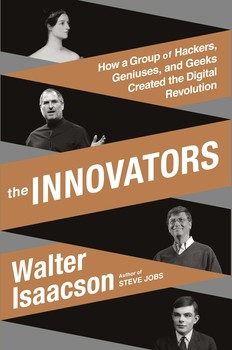
I don’t know how a search engine could “basically understand everything in the world”, probably because I don’t understand how computers work. (Actually, I don’t even really comprehend how television works —  or radios, for that matter.)  I’m perfectly content to think of them as miraculous and mysterious inventions. What interests me are the workings of the minds of the people who developed the computer and the Internet. I just started reading The Innovators: How a Group of Geniuses, Hackers, and Geeks Created the Digital Revolution, by Walter Isaacson (author of Steve Jobs) — it’s absolutely fascinating, focusing on how teamwork enhances creativity.

As I was reading the first chapter of The Innovators, I found myself Googling various things that piqued my interest. Several of my searches directed me to blogs, which made me wonder what Google searches led people to Books on the Table.  I found information about “referrers” and “search terms” on the stats page for the blog, and was not surprised to learn that Google is by far the largest referrer to Books on the Table, accounting for 87% of all Internet searches that led to the blog. What did surprise me was that Google’s privacy restrictions prevented me from knowing what search terms people used that connected them with Books on the Table.

Other search engines (Bing, Yahoo, AOL, etc.) do provide information about specific search terms. The most popular searches were: “Good books for book clubs”; “What happened to the diamond in All the Light We Cannot See?”; and “We Are Liars book review”.  One person asked a question that I think requires human, not artificial, intelligence: “If members of my book club hate the book I chose what does this tell me?” (OK, Larry Page, explain how the “ultimate search engine” would respond to that.) Maybe I shouldn’t be surprised at this question, since I read in a Google promotional piece that the number one question asked on Google this year is  “What is love?”.

Here are a few of the most unusual search terms that somehow led readers to Books on the Table in 2014:

  • Term paper on Jay Gatsby Do I detect possible plagiarism?
  • Rick Maus marijuana grower and book writer This one intrigued me, but my search turned up only an article in Sugarbeet Grower magazine about a device used in harvesting beets
  • Best novels by W.B. Yeats Well, I think he did write a short story or two.
  • Book about young girl who have a time mashine and meet Al Capone I think I might know this one! It could be Al Capone Does My Shirts — although I don’t recall a “time mashine”.
  • Francine Fleece Seattle This is mysterious, since I searched myself and came up with no results. However, three people were looking for the elusive Francine Fleece.
  • Mob Wives Chicago still on the air? Don’t search engines know that Books on the Table doesn’t cover reality TV?
  • Book club cocktail napkins There were many searches for these. Maybe Books on the Table should start selling them?
  • Is Sarah Churchwell married? Four people wanted to know this. I checked, and Churchwell (author of the terrific book Careless People: Murder, Mayhem, and the Invention of The Great Gatsby, coming in paperback in January) is married. If things don’t work out for her, there may be plenty of potential suitors out there.

Happy New Year! May all your Internet searches be fruitful in 2015.


Why Proofreading Matters — Or, I’m Officially a Curmudgeon

imgresI read a lot of advance readers’ copies (ARCs). They all contain some version of this disclaimer:

Uncorrected proof: Please do not quote without comparison with finished book.

I get distracted when I’m absorbed in an ARC and I encounter a spelling or grammatical error. But I don’t begrudge anyone, because I was warned. However, when I read a finished book I don’t expect to see errors. Recently, I’ve been finding a lot of mistakes in published books.  Yesterday, at Printers Row Lit Fest, I picked up a copy of Megan Stielstra’s fantastic essay collection, Once I Was Cool.  I’d seen a great review of the book in the Chicago Tribune and was eager to read it. I started the book last night and finished it this morning, and I wholeheartedly agree with Beth Kephardt’s review — it is definitely “edgy, funny, surprising, a ricochet of wow”. (I could have done without the profanity, but maybe that’s because I’m not, nor have I ever been, “cool”.)

Here’s one way I know Once I Was Cool is an amazing book: I couldn’t stop reading it even though it was full of spelling errors. “Relator” for “realtor” (more than once); “assessements”; “bounncing” ; “MacBeth”. Every time I hit an error, my reading flow was disrupted. I know that Stielstra knows how to spell those words, and I know she knows grammar. Her mother, a teacher, instilled in her a deep love of reading and also taught her the importance of proper grammar:

Grammar was an important thing in our family. While my friend Becky and I were welcome to ride our bikes to the library, me and Becky most certainly could not.

Spelling and grammar are important to me, too. Am I an uptight fussbudget? Is it wrong that I was annoyed when the people in charge of my children’s education sent home a flyer signed “All the middle school teacher’s”? Or that I feel the urge to correct the chalkboard outside a deli that offers “Fresh sandwichs $6.99”?

Our store is so quaint that we still regularly mail a newsletter to our customers, with book recommendations and upcoming events. Once, someone anonymously sent the newsletter back to us with an error circled in red ink (I think the error was a misplaced comma), with an admonishment: “You need to proofread!” Not very nice, but it certainly made us more vigilant about proofreading.

Once I Was Cool was published by a small press, Curbside Splendor.  I’m sure they operate on a shoestring, and I’m willing to give them some leeway. Maybe I’ll volunteer to proofread for them. I once had a job in pharmaceutical marketing and I was required to proofread package inserts for prescription drugs. I was told that if we published an ad with an error in the package insert section, we could be sued and our whole team would probably be fired. (It turned out that our whole team did get fired, but not because of a spelling error.)

Of course, anyone, even a persnickety person like me, can make an embarrassing mistake. Recently, I updated the store’s website with the news that a particular “pubic” library would be hosting an author event. I received a very polite email, with a signature, suggesting that I might want to correct this . . .  immediately.

Anyone, including the overworked and underpaid people at Curbside Splendor Press, can make typographical errors. Is it best to point these out gently, or ignore them? I vote for letting people know about their mistakes, in the kindest way possible. In one of my favorite essays, simply called “Nice”, Megan Stielstra says:

If someone cuts you off in traffic, let it go, it doesn’t matter in the grand, glowing scheme of you and me and all of us breathing a little easier. Above all else, when you get home tonight, write these words on a Post-it note: BE KIND, FOR EVERYONE IS FIGHTING A HARD BATTLE.*
Stick that Post-it to your bathroom mirror and read it every morning, before you leave the house:
BE KIND.
BE KIND.
BE KIND.
*This has been attributed to Plat, Philo of Alexandria, and John Watson aka Ian MacLaren. My thanks to all those guys.

I’m a middle-aged suburbanite and probably not Stielstra’s intended reader, but I found a lot of wisdom and humor in her essays. Stielstra frequently appears at live storytelling events in Chicago. I’d love to see her perform — I wouldn’t have to worry about being distracted by spelling errors!

STL150


10 War Novels for Memorial Day

Not only are they commemorated by columns and inscriptions, but there dwells also an unwritten memorial of them, graven not on stone but in the hearts of men.
Pericles, Funeral Oration ( delivered in Athens 2500 years ago and a source of inspiration for Abraham Lincoln’s Gettysburg Address)

Memorial Day is almost over, and I’m finally getting to my Monday blog post — so this will be short.  (I guess I should have written it ahead of time!) I’ve just returned from my son Charlie’s college graduation. He’s now on a cross-country road trip, starting in Ithaca, New York and ending in San Francisco. His first stop was Gettysburg, where he saw as much of the battlefield and monuments as he could until the sun set. To coin Lincoln’s phrase, it seems “altogether fitting and proper” that Charlie visited Gettysburg on the day that has been set aside to honor those who died while serving in our armed forces.

Michael Shaara’s Pulitzer Prize winning novel about the Battle of Gettysburg, The Killer Angels, is a modern classic. I have to admit I’ve never read it, but my husband (a true Civil War buff) says it’s well worth reading. My list of favorite war novels includes books about the Civil War, and World Wars I and II as well:

coverCorelli’s Mandolin  (Louis deBernieres) There’s just a touch of magical realism in this lovely novel about a Greek island that’s occupied by the Italian army during World War II.

City of Thieves  (David Benioff) During the siege of Leningrad, two Russians must carry out an impossible task — or face execution.

Restless  (William Boyd) An English woman learns that her mother is a White Russian who was recruited by the British as a spy. From the New York Times: “Boyd has written a crackling spy thriller, but more than that, he has evoked the atmosphere of wartime espionage: the clubby, grubby moral accommodations, the paranoia . . .”

The Absolutist (John Boyne ) From Publishers Weekly: “In this relentlessly tragic yet beautifully crafted novel, Boyne documents the lives of two inseparable men navigating the trenches of WWI and the ramifications of a taboo involvement.”6d2d32a98c258c6c1a7b112eda9968b9

Birdsong (Sebastian Faulks) A young Englishman falls in love with a married French woman during a business trip to France in 1910; they meet again, during World War I. I read this for the first time about 15 years ago, and have never forgotten the vivid scenes of trench warfare, or the love story.

The Widow of the South (Robert Hicks) Based on the true story of Carrie McGavock, who tended the graves of the 1,500 soldiers buried on her family’s land. We visited the actual site in Franklin, Tennessee last fall.

A Very Long Engagement (Sebastian Japrisot) A French woman who doesn’t believe her fiancé was killed in the First World War embarks on an investigation and discovers the corrupt system the French government used to deal with soldiers who tried to avoid combat.

Gone With the Wind  (Margaret Mitchell) I don’t know how many times I read this book as a teenager, but my old paperback copy is falling apart. I can even remember the first sentence, without looking: “Scarlett O’Hara was not beautiful, but men seldom realized it when caught by her charm as the Tarleton twins were.”

cover-1The Invisible Bridge  (Julie Orringer) The best World War II novel I’ve read in the past few years.  From the Chicago Tribune: “Set largely in Hungary, with Paris, the city of light, serving as a kind of Byzantium for several characters who spend hopeful, youthful years there in the opening chapters of the novel, The Invisible Bridge is a tale of war-torn lovers, family and survival of the luckiest rather than the fittest.”

The Caine Mutiny (Herman Wouk) An old favorite, The Caine Mutiny takes place on a Navy warship in the Pacific. I’ve loved all of Herman Wouk’s books — The Winds of War, War and Remembrance, and two wonderful (and unappreciated) coming-of-age stories — Marjorie Morningstar and City Boy. (No, they’re not war novels, but since I’m touting Herman Wouk I have to mention them!)

I’ve read very little fiction about the more recent wars. On my list are Matterhorn by Karl Marantes  (Vietnam), The Yellow Birds by Kevin Powers (Iraq), and Redeployment (Iraq and Afghanistan). I read Sparta by Roxana Robinson, about Conrad, a young veteran returning from Iraq who has difficulty readjusting to civilian life. Conrad is a classics major at Williams College from an upper-middle class (and decidedly unmilitary family) from suburban New York City. When he comes home suffering from PTSD, his family is too bewildered to offer any meaningful help. The book was insightful in many ways, but I couldn’t fathom the idea that a family like Conrad’s would abandon him to the bureaucracy of the VA.

Our next national holiday is July 4. I plan to read a contemporary war novel by then and let you know what I think. If you have any other suggestions, I’d love to hear them.

Charlie at Gettysburg, May 26, 2014