See that little stream—we could walk to it in two minutes. It took the British a month to walk it—a whole empire walking very slowly, dying in front and pushing forward behind. And another empire walked very slowly backward a few inches a day, leaving the dead like a million bloody rugs.
F. Scott Fitzgerald, Tender is the Night
Yesterday, our town’s commuter train station was full of veterans selling handmade poppies. Poppies came to symbolize sacrifice and remembrance after World War I, when Canadian surgeon Colonel John McCrae’s poem, “In Flanders Fields”, touched the hearts of millions:
In Flanders fields the poppies blow
Between the crosses, row on row,
That mark our place; and in the sky
The larks, still bravely singing, fly
Scarce heard amid the guns below.
It’s impossible to comprehend the enormous tragedy of World War I. The statistics are shocking — for example, Germany and Russia both lost 1.7 million soldiers; France lost 1.3 million; and Great Britain lost close to 1 million. The United States, which entered the war in 1917, lost 126,000 soldiers. To learn more about America’s involvement in the  First World War, I recommend Richard Rubin’s The Last of the Doughboys: The Forgotten Generation and Their Forgotten World War. (Also, don’t miss Willa Cather’s One of Ours, which won the Pulitzer Prize for fiction in 1923.) For the French perspective, Jeff recommends Poilu: The World War I Notebooks of Corporal Louis Barthas, Barrelmaker, 1914-1918, a new translation of the actual wartime diaries of a French soldier.
Most of my World War I reading has been historical fiction about the British experience. I’ve mentioned several of my favorites before (A Long Long Way, The Absolutist, Birdsong) but I’ve neglected some others . . . and I’ve just finished reading a terrific new novel.
 The Summer Before the War, by Helen Simonson (the author of Major Pettigrew’s Last Stand), is a kinder, gentler World War I book than most. The story centers on Beatrice Nash, a young Latin teacher who arrives in the small village of Rye during the summer of 1914. Determined to make her own way after the death of her beloved father, Beatrice is thwarted by the sexist mores of the times. She befriends a local family, the Kents, whose nephews — each for his own complicated reasons — volunteer to serve in France soon after war is declared. Beatrice is the most endearing character I’ve come across for a long time. She always has a quick comeback, even when faced with a supercilious solicitor or an arrogant American author. I loved every page of this book, which NPR says “rivals Simonson’s first in the charm department.” Yes, it’s charming — but it’s also poignant and beautifully written. You might even shed a tear or two. (By the way, if you’re suffering from Downton Abbey withdrawal, this is the book for you.)
 I’ve also enjoyed Jacqueline Winspear’s Maisie Dobbs series. Maisie Dobbs, the heroine, is a World War I veteran, having served as a battlefield nurse. After the war, she trains with famous private investigator Dr. Maurice Blanche, and when he retires, she sets up her own detective agency. In most of the 12 novels, Maisie solves a complex case in which First World War events play a role. In her review of the first book in the series, New York Times book reviewer Marilyn Stasio says: “Romantic readers sensing a story-within-a-story won’t be disappointed at the sensitivity and wisdom with which Maisie resolves her first professional assignment, an apparent case of marital infidelity that turns out to be a wrenching illustration of the sorrowful legacies of World War I.” I recommend reading Winspear’s moving essay about her first visit to the battlefields of the Somme and Ypres, where her grandfather saw action in 1916.
For more about our visit to Verdun, site of one of the largest battles in World War I, please see Remembering World War I. And for a list of my favorite war novels, check out 10 War Novels for Memorial Day. (I recently learned that the difference between Memorial Day and Veterans Day, in the United States is that Memorial Day honors men and women who have died while serving in the military, while Veterans Day honors all those who who have served their country.)

 More than 500 authors are on hand to sign their books, and attendees queue up — sometimes for hours — to meet their favorite authors and receive personally inscribed books. I don’t have the patience to stand in line for much of anything, unless I’m forced to wait in a TSA line at the airport, so I didn’t get any signed books. If I were less antsy, I would have enjoyed meeting Candice Millard (signing Hero of the Empire: The Boer War, a Daring Escape, and the Making of Winston Churchill, coming in September), Jonathan Safran Foer (signing Here I Am, due in September and his first novel since Extremely Loud and Incredibly Close in 2005), Emma Cline (signing The Girls, her debut novel, which is the #1 Indie Pick for June), Amor Towles, author of Rules of Civility (signing A Gentleman in Moscow, out in September), Richard Russo (signing Everybody’s Fool, his follow-up to Nobody’s Fool), and dozens of others.
 OK, point taken. I’m not a book hoarder or a bibliomaniac — but I do have a hard time culling my bookshelves. (For more on my difficulties in this area, see
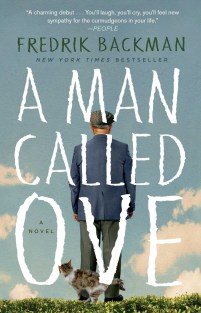
  She just smiled, said that she loved books more than anything, and started telling him excitedly what each of the ones in her lap was about. And Ove realised that he wanted to hear her talking about the things she loved for the rest of his life.
 Fredrik’s novels, bestsellers in Sweden, the United States, and dozens of other countries, hit the sweet spot for readers looking for fiction that’s charming, humorous, and a bit quirky — but not corny. They’re the kind of books that people fall in love with and give to all their friends. One of Fredrik’s editors told Publishers Weekly: “I think Fredrik is different from the dark crime writers and doing something different from writers in general . . . He has such a distinctive voice and point of view. He might be the herald of a larger trend in Scandinavian literature, but I think he’s doing his own thing.”
 Fredrik Backman on:
 Britt-Marie:
 The classic Swedish picture books about triplets Snipp, Snapp and Snurr and Flicka, Ricka and Dicka:
 As a child, I thought of bridge as a mysterious game that parents played, in the afternoons when I was at school or in the evenings when I was in bed. The most complicated card games I knew were hearts, gin rummy, and cribbage. Recently, I became intrigued by the idea of bridge as mental exercise for my aging brain. My half-hearted attempt to learn the game met with failure, when the teacher at the community center recommended that I repeat the beginning course. This course was very basic; in fact, the teacher spent some time explaining that there are four suits in cards, two black and two red, and that the clubs look just like puppy paws.
 Pamela Wechsler, an attorney who spent many years as a criminal prosecutor in Boston and later became a consultant and writer for several TV shows, met the actor Billy Bob Thornton while she was a legal advisor on his movie, The Judge. Thornton — who won an Academy Award for writing the Sling Blade script — encouraged Wechsler to write a novel. The result is the page-turner Mission Hill, first in a planned series about Abby Endicott, a blue-blooded Boston prosecutor whose family expects her to join a white-shoe law firm but opts for the gritty world of criminal law. Thornton’s blurb is better than any description I could come up with: “Pam Wechsler delivers a thrill ride, crackling with suspense, wit and style. The story is rich, the characters are complex, and the writing is deft. I can’t wait for the next one.” I’m with Billy Bob! Watch for an interview with Wechsler on Books on the Table — but I warn you, the interview I just read on a website called
  Elizabeth J. Church, author of The Atomic Weight of Love, is also an attorney. Church, who’s published scholarly articles in legal and scientific journals as well as short stories, left the law after practicing for 30 years. She grew up in Los Alamos, New Mexico, the daughter of a research chemist who worked on the Manhattan Project during World War II. Church’s debut novel was inspired by the lives of her parents and their contemporaries. Meridian (Meri), a young biology student at the University of Chicago, marries her much older professor, Alden, and gives up her own dreams of becoming an ornithologist when her husband is sent to Los Alamos to help develop the atomic bomb. This lovely novel of love, sacrifice, and societal change spans 30 years in Meri and Alden’s flawed marriage. This would be a perfect book club selection — beautiful writing and plenty of issues to discuss. (Meri’s own experiences with women’s discussion groups are not very successful!)
 Squash champion Maria Toorpakai, author of the stunning memoir A Different Kind of Daughter: The Girl Who Hid From the Taliban in Plain Sight, risked her life to become a professional athlete. For over two years, death threats forced her to practice squash in her cement-walled bedroom. Born in Waziristan, the Taliban-dominated Federally Administered Tribal Area of northwest Pakistan, Toorpakai lived as a boy until she was sixteen. Her loving and liberal family supports her dream of athletic success, eventually allowing her to flee Pakistan and train with Jonathon Power, the world champion squash player who now runs the Power Squash Academy in Toronto. The human rights abuses that the Toorpakai vividly describes are numerous and shocking — as a young girl, is beaten by a mullah for showing an interest and athletics, and she sees a woman stoned to death. Don’t miss this powerful and inspiring memoir. I can’t wait to see Power’s documentary about Toorpakai’s s The War to Be Her, scheduled for release in September. (Special thanks to Aidan Harrison, squash pro at the Onwentsia Club in Lake Forest, Illinois and friend of Jonathon Power, who alerted me to Toorpakai’s amazing story.)
 Books on the Table