She just smiled, said that she loved books more than anything, and started telling him excitedly what each of the ones in her lap was about. And Ove realised that he wanted to hear her talking about the things she loved for the rest of his life.
Fredrik Backman, A Man Called Ove
Earlier this week, I had the pleasure of interviewing Swedish author Fredrik Backman (author of A Man Called Ove, My Grandmother Asked Me to Tell You She’s Sorry, and Britt-Marie Was Here) at his very first event on his first book tour in the United States. Fredrik arrived in Chicago on the evening of Tuesday, May 10, spent the following afternoon in the Simon & Schuster booth at Book Expo of America (BEA) signing books and chatting with booksellers, librarians, and other publishing industry people, and then, with his publicist and agent, battled rush hour traffic to speak to a sold-out crowd in Lake Forest.
 Fredrik’s novels, bestsellers in Sweden, the United States, and dozens of other countries, hit the sweet spot for readers looking for fiction that’s charming, humorous, and a bit quirky — but not corny. They’re the kind of books that people fall in love with and give to all their friends. One of Fredrik’s editors told Publishers Weekly: “I think Fredrik is different from the dark crime writers and doing something different from writers in general . . . He has such a distinctive voice and point of view. He might be the herald of a larger trend in Scandinavian literature, but I think he’s doing his own thing.”
Readers all over the world respond to Fredrik’s wit and wisdom. A customer at Lake Forest Book Store showed me her dog-eared copy of My Grandmother Asked Me to Tell You She’s Sorry, with many favorite passages underlined. I wonder if she underlined my favorite quotation from the book: “Having a grandmother is like having an army. This is a grandchild’s ultimate privilege: knowing that someone is on your side, always, whatever the details.”
Fredrik delighted the audience at our event with funny anecdotes (shopping at Ikea with his father) and with serious commentary (developing three-dimensional characters). Here are some highlights of our conversation.
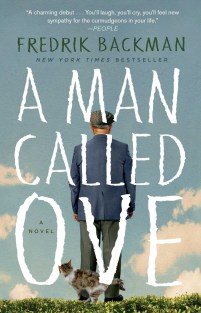 Fredrik Backman on:
How to say “Ove”:
Pronounce it like “Hoover”, the vacuum cleaner.
How he develops his novels:
I start out with characters. Some writers start out with a story, and fit the characters into the story as they go along . . . I start at the other end, with characters . . . people that I find funny or interesting.
 Britt-Marie:
My wife, when she read the manuscript, said “You’ve never written anything about a character who’s so much like you.” She’s passive-aggressive, while Ove’s active-aggressive. I wanted to write a coming -of-age story, this great adventure where someone leaves their home, but those stories are always written about 20-year-old men . . . and I wanted to write a coming-of-age story about a 63-year-old woman, because she’d never left home.
The secret to writing a bestseller:
I don’t know — I really wish I had an answer. People think I have a formula (“this is how you write a bestseller”) — I have no idea. The only thing I figure is that probably I like the same things a lot of other people like. I don’t have original taste in things. The TV shows and movies I like are things that millions of other people like. There are a lot of really, really talented, gifted brilliant writers and if you ask them, what books do you like, they say, “Oh, there’s this French drama that no one’s ever heard of”, or “Oh, there’s this monk who wrote a book, there are only three copies and I have one of them”. I’m not capable of writing anything hard for people to understand.
To become a bestseller, it doesn’t mean that this many people thought your book was the best one they ever read. It means this many people thought it was OK.
Swedish literature:
We like crime. Probably because we don’t have a lot of it in real life. There’s, like, two people in Sweden who have guns. If you’re going to write crime you start with a very, very nice place, an idyllic place. Because then it becomes much scarier when someone does something horrible.
The movie version of A Man Called Ove:
You have to view it as an interpretation — it’s like someone making a cover of a song. My mom hasn’t said it out loud, but it’s very obvious she liked the movie more than she liked the book. From my dad’s reaction, I could see that my mom has had a long-time crush on the actor who plays Ove. She said, “Wasn’t it wonderful when he . . .” and I said, “I know, I wrote that! I made that up . . . in my head”.
 The classic Swedish picture books about triplets Snipp, Snapp and Snurr and Flicka, Ricka and Dicka:
You’ve lost me.
I couldn’t believe neither Fredrik nor his agent, who was on tour with him, had heard of Maj Lindman’s charming children’s books, which were published in the United States in the 1930s and are still in print: “Snipp, Snapp, and Snurr were three little boys who lived in Sweden. They had blue eyes and yellow hair, and they looked very much alike.” I’ve just ordered a copy of one of my favorites (Snipp Snapp Snurr and the Gingerbread) and will be sending it as a thank you gift for Fredrik to share with his children — who will soon be old enough for one of the most memorable characters in children’s literature, Swedish tomboy Pippi Longstocking.
 As a child, I thought of bridge as a mysterious game that parents played, in the afternoons when I was at school or in the evenings when I was in bed. The most complicated card games I knew were hearts, gin rummy, and cribbage. Recently, I became intrigued by the idea of bridge as mental exercise for my aging brain. My half-hearted attempt to learn the game met with failure, when the teacher at the community center recommended that I repeat the beginning course. This course was very basic; in fact, the teacher spent some time explaining that there are four suits in cards, two black and two red, and that the clubs look just like puppy paws.
 Pamela Wechsler, an attorney who spent many years as a criminal prosecutor in Boston and later became a consultant and writer for several TV shows, met the actor Billy Bob Thornton while she was a legal advisor on his movie, The Judge. Thornton — who won an Academy Award for writing the Sling Blade script — encouraged Wechsler to write a novel. The result is the page-turner Mission Hill, first in a planned series about Abby Endicott, a blue-blooded Boston prosecutor whose family expects her to join a white-shoe law firm but opts for the gritty world of criminal law. Thornton’s blurb is better than any description I could come up with: “Pam Wechsler delivers a thrill ride, crackling with suspense, wit and style. The story is rich, the characters are complex, and the writing is deft. I can’t wait for the next one.” I’m with Billy Bob! Watch for an interview with Wechsler on Books on the Table — but I warn you, the interview I just read on a website called
  Elizabeth J. Church, author of The Atomic Weight of Love, is also an attorney. Church, who’s published scholarly articles in legal and scientific journals as well as short stories, left the law after practicing for 30 years. She grew up in Los Alamos, New Mexico, the daughter of a research chemist who worked on the Manhattan Project during World War II. Church’s debut novel was inspired by the lives of her parents and their contemporaries. Meridian (Meri), a young biology student at the University of Chicago, marries her much older professor, Alden, and gives up her own dreams of becoming an ornithologist when her husband is sent to Los Alamos to help develop the atomic bomb. This lovely novel of love, sacrifice, and societal change spans 30 years in Meri and Alden’s flawed marriage. This would be a perfect book club selection — beautiful writing and plenty of issues to discuss. (Meri’s own experiences with women’s discussion groups are not very successful!)
 Squash champion Maria Toorpakai, author of the stunning memoir A Different Kind of Daughter: The Girl Who Hid From the Taliban in Plain Sight, risked her life to become a professional athlete. For over two years, death threats forced her to practice squash in her cement-walled bedroom. Born in Waziristan, the Taliban-dominated Federally Administered Tribal Area of northwest Pakistan, Toorpakai lived as a boy until she was sixteen. Her loving and liberal family supports her dream of athletic success, eventually allowing her to flee Pakistan and train with Jonathon Power, the world champion squash player who now runs the Power Squash Academy in Toronto. The human rights abuses that the Toorpakai vividly describes are numerous and shocking — as a young girl, is beaten by a mullah for showing an interest and athletics, and she sees a woman stoned to death. Don’t miss this powerful and inspiring memoir. I can’t wait to see Power’s documentary about Toorpakai’s s The War to Be Her, scheduled for release in September. (Special thanks to Aidan Harrison, squash pro at the Onwentsia Club in Lake Forest, Illinois and friend of Jonathon Power, who alerted me to Toorpakai’s amazing story.)
 The Underdogs: Children, Dogs, and the Power of Unconditional Love by Melissa Fay Greene
 Following Atticus: Forty-eight High Peaks, One Little Dog, and an Extraordinary Friendship by Tom Ryan
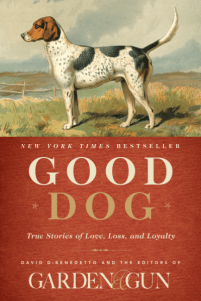 Good Dog: True Stories of Love, Loss, and Loyalty by David DiBenedetto and the editors of Garden & Gun
 Off the Leash: A Year at the Dog Park by Matthew Gilbert

 I stayed up way too late reading Lilac Girls, Martha Hall Kelly’s debut novel. Anyone who loved The Nightingale, Salt to the Sea, The Invisible Bridge, or All the Light We Cannot See will find this book both unforgettable and hard to put down. Historical fiction at its best, the novel tells the powerful story of female prisoners subjected to medical experimentation at the hands of the Nazis. Three narrators — a Polish teenager, a German doctor, and an American humanitarian, all based on real women, lend their distinctive voices to this meticulously researched story of heartbreak and courage.
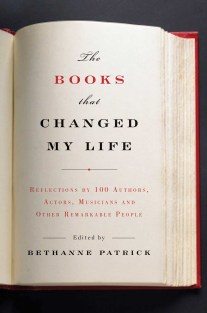 Like most book lovers, I adore books about books, and I thoroughly enjoyed Bethanne Patrick’s The Books That Changed My Life: Reflections by 100 Authors, Actors, Musicians, and Other Remarkable People. It’s a perfect book for your nightstand, because each of the essays is no more than three pages long. Each essay writer starts with a selection of a a life-altering book and a quotation from that book. They run the gamut from Gillian Flynn, who chose The Westing Game, to Rosanne Cash, who picked The Little House on the Prairie, to Tim Gunn, who selected Let Us Now Praise Famous Men. Bethanne Patrick says:
 Margaret Sanger — nurse, birth control pioneer, social activist, free love advocate — led a big life. Too big to be contained in the pages of Ellen Feldman’s slim, fast-paced biographical novel, Terrible Virtue. I read Terrible Virtue in one afternoon, and although the book held me captive, it left me wanting more. Feldman races through Sanger’s long and eventful life, starting with her childhood as one of eleven siblings in a poor Irish Catholic family in upstate New York.
 Feldman presents Margaret Sanger not as a saint or a sinner, but as a complex, flawed visionary, driven not only by her passion for social justice and her vision of a better world, but by her own egotism. The reader feels both sympathy for the personal tragedy she endures and anger at her treatment of her family. Feldman, who tells most of the story from Margaret’s perspective, successfully uses short, straightforward sentences and an urgent tone to capture her voice. When Feldman breaks up Margaret’s narrative to include asides from other characters, addressed to Margaret, she is less successful. These sections, which don’t sound as though they are based on actual correspondence, are intended to add depth to Margaret’s portrayal, but they ring false to me.
 Several years ago, Jeff and I visited Dublin for a few days. It was a perfect trip for a history buff (Jeff) and a literature lover (me). We explored the Dublin Writers’ Museum, saw the Joyce statue on O’Connell Street, waited in line to see the Book of Kells at Trinity College, toured Kilmainham Gaol (Jeff’s idea, not mine), went to several plays, and stopped by more than our share of pubs. (We didn’t, however, retrace Leopold Bloom’s route through the city on the guided walk offered by the Joyce Cultural Centre. ) As someone who relied on the CliffsNotes to get through Ulysses, I didn’t feel entitled to take that tour!) We did have dinner at the Winding Stair on the River Liffey. Downstairs is one of the oldest independent bookshops in Dublin and upstairs is a restaurant serving “good, old-fashioned home cooking”.
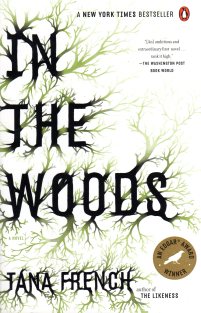 I always like to read something about the place I’m visiting, so on the flight to Dublin I read In the Woods by Tana French. It’s a murder mystery/psychological thriller, featuring two detectives from the Dublin Murder Squad trying to solve two murders that have taken place 20 years apart. I’m not usually much of a mystery reader, but this one captivated me because of the gorgeous writing and the evocation of modern Ireland, in addition to the complex puzzle of two parallel crimes. One of those crimes is never solved; this is not a formulaic mystery. In an interview, Tana French describes her favorite mystery novels:
 If I had to choose a favorite Irish author, it would be a tie between Colm Toíbín and Sebastian Barry. When you read one of Barry’s novels, you know you are reading the work of a poet. (Barry is in fact the author of two collections of poetry and numerous plays, in addition to eight novels.) The New York Times says, “Mr. Barry has said that his novels and plays often begin as poems . . . but his language never clots the flow of his story; it never gives off a whiff of labor and strain. It is like a song, with all the pulse of the Irish language, a song sung liltingly and plaintively from the top of Ben Bulben into the airy night.” You can choose at random almost any passage from any one of his novels and be struck by the beauty of the language, but here’s one of my favorites, from A Long Long Way:
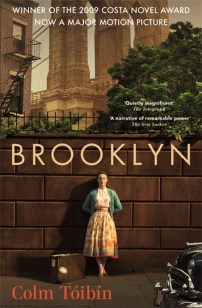 Colm Toíbín, like Sebastian Barry, is a versatile wordsmith — he’s written novels, short stories, essays, plays, poems, criticism, and nonfiction. I haven’t read all his books, but I loved The Master, The Testament of Mary, and Brooklyn. Although Toíbín’s work has been shortlisted for the Man Booker Prize several times and has received plenty of critical acclaim, he hit the jackpot recently when his 2009 novel, Brooklyn, was made into a successful movie that received three Academy Award nominations — Best Picture, Best Actress, and Best Adapted Screenplay. ToíbÍn’s deceptively simple story of a young Irish immigrant, Eilis, who comes to the United States in the 1950s is a powerful meditation on love and belonging. Horribly homesick at first, Eilis falls in love and begins to make a life for herself in New York. A tragedy calls her home to Ireland and she is torn between her two lives. Toíbín’s description of Eilis’s loneliness as a new immigrant will resonate with anyone who has ever felt friendless and alone:
 Smith said “trying to get in the heads of 18th century men was a thrill for me.” While I thought the men’s voices were authentic for the most part, in some instances the characters slip into the mindsets of modern-day Americans. For example, would an 18th century slave say, “. . . this was not a life but a system, and for the first time my boyish grief took on the color of rage”?
 As soon as March arrives, customers start asking for spring break reading recommendations for themselves and their families. You’d think it would be easy to come up with a list of fun “beach reads”, but every year that request flummoxes me. I understand that lots of people want to read lightweight books while on vacation, but far too many books pegged as “escape” reading are too predictable to be entertaining. I don’t think I’m a book snob, but if I’m going to spend six or more hours reading a book, I want to feel I’ve been enlightened as well as entertained. I want to gain something, whether it’s a little better understanding of human nature or concrete knowledge.
 H is for Hawk by Helen Macdonald
 The Residence: Inside the Private World of the White House by Kate Andersen Brower
 The Swans of Fifth Avenue by Melanie Benjamin
 This Was Not the Plan by Cristina Alger
 Back in the 1980s, film critic David Denby wondered “how anyone could be hurt by reading a good book”. The controversy at the time, which continues to this day, was how we define a “good book” and whether the traditional Western classics are relevant in our multicultural society. The 48-year-old Denby returned to his alma mater, Columbia University, and spent a full academic year studying the Western canon. He wrote a book, Great Books: My Adventures with Homer, Rousseau, Woolf, and the Indestructible Writers of the Western World, about how the experience reinvigorated his intellectual life.
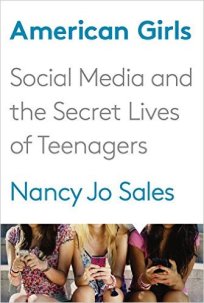 I read this book just after I finished another book about American teenagers, American Girls: The Secret Lives of American Teenagers, by Nancy Jo Sales, which is truly one of the most depressing books I’ve ever read. If Sales is to be believed — and I hope with all my heart she’s not — the lives of most teenage girls revolve around taking pictures of themselves and posting them online, hoping for validation. In this book, physical appearance is everything, the search for male approval is paramount, and feminism is completely dead. A recent Wall Street Journal review said: “The secret life of teenagers sometimes seems entirely a response to nude pictures and requests for them—a response, that is, to male adolescent desire, as it shows up digitally. But female vanity is also at play.”
 Books on the Table