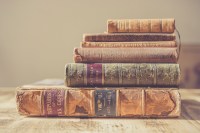
Bibliomania: a mild form of insanity which is obtaining wide prevalence. A bibliomaniac must be carefully distinguished from a bibliophile. The latter has not yet freed himself from the idea that books are meant to be read.
Thomas Walsh, Handy-Book of Literary Curiosities (1892)

Last week, I went to the book industry’s annual trade show, BookExpo America (BEA) at McCormick Place in Chicago. The stated purpose of this event is for booksellers, librarians, educators, and publishing professionals to “discover new titles and authors, conduct business and network, and learn the latest trends”. What it is for many attendees is the opportunity to grab as many free books as they can carry. There’s a reason the show prohibits “carts, luggage on wheels, and empty strollers”. Publishers distribute canvas tote bags emblazoned with their logos or the cover of one of their hottest titles, and bibliophiles (or are they bibliomaniacs?) rush to fill those bags.
 More than 500 authors are on hand to sign their books, and attendees queue up — sometimes for hours — to meet their favorite authors and receive personally inscribed books. I don’t have the patience to stand in line for much of anything, unless I’m forced to wait in a TSA line at the airport, so I didn’t get any signed books. If I were less antsy, I would have enjoyed meeting Candice Millard (signing Hero of the Empire: The Boer War, a Daring Escape, and the Making of Winston Churchill, coming in September), Jonathan Safran Foer (signing Here I Am, due in September and his first novel since Extremely Loud and Incredibly Close in 2005), Emma Cline (signing The Girls, her debut novel, which is the #1 Indie Pick for June), Amor Towles, author of Rules of Civility (signing A Gentleman in Moscow, out in September), Richard Russo (signing Everybody’s Fool, his follow-up to Nobody’s Fool), and dozens of others.
On social media, BEA attendees post photos of their book “hauls” and brag about how many books they snagged. It’s an interesting psychological phenomenon, with several factors influencing the rush to accumulate books. They’re free; there’s the perception of scarcity, since publishers can only bring a limited number of each title; and many of the books have a lot of marketing hype behind them. I think almost everyone ends up bringing home a “pity book” or two. I know I did. A hopeful-looking author sat on a stool at a podium in a small press’s booth, with a pile of books beside him and only his publisher for company. I stopped, feigned interest in his collection of “prose poems”, and added a signed copy to my bag. (I was not so polite to the friendly salespeople at two combined booths — Bridge Publications and Galaxy Press, both publishers of L. Ron Hubbard’s works on Scientology.)
I promised myself I would only gather a few carefully chosen books that I knew I would read, because I am a bibliophile, not a bibliomaniac. Nancy Bass Wyden, co-owner of the Strand Bookstore in New York City, told the Wall Street Journal that she owns 2,000 books but only displays 500 at a time:
The key to a healthy book collection, Ms. Wyden says, is constant editing. When she adds a book, she tries to take something out. “If it keeps getting tweaked, what you have is more meaningful,” she says. “It keeps your library fresh, and you feel more engaged with what’s in there.”
I ended up lugging home 20 books from BEA that I just couldn’t resist. Now, in order to keep my library “fresh”, I guess I’ll have to get rid of 20 books — some of which are probably unread books I brought home from book conferences in years past, with honorable intentions.
I googled the term “book hoarder” and learned that it is considered offensive. Jessie Sholl, author of a memoir about growing up as the daughter of a compulsive hoarder, writes in Psychology Today:
You might have packed bookcases and, yes, too many books, but that doesn’t mean you’re a book hoarder. If I skipped lunch one day, or two, or three, would that suddenly make me anorexic? If I labeled myself as such, I’d surely be accused of being insensitive to those who truly have a mental illness — and rightly so.
 OK, point taken. I’m not a book hoarder or a bibliomaniac — but I do have a hard time culling my bookshelves. (For more on my difficulties in this area, see Why My Books Are Not Clutter.) I’ll need to make room for The Wonder (Emma Donoghue), The Book That Matters Most (Ann Hood), The Excellent Lombards (Jane Hamilton), Truevine: Two Brothers, a Kidnapping, and a Mother’s Quest: A True Story of the Jim Crow South (Beth Macy) . . . or I could just get some new bookshelves!
 She just smiled, said that she loved books more than anything, and started telling him excitedly what each of the ones in her lap was about. And Ove realised that he wanted to hear her talking about the things she loved for the rest of his life.
 Fredrik’s novels, bestsellers in Sweden, the United States, and dozens of other countries, hit the sweet spot for readers looking for fiction that’s charming, humorous, and a bit quirky — but not corny. They’re the kind of books that people fall in love with and give to all their friends. One of Fredrik’s editors told Publishers Weekly: “I think Fredrik is different from the dark crime writers and doing something different from writers in general . . . He has such a distinctive voice and point of view. He might be the herald of a larger trend in Scandinavian literature, but I think he’s doing his own thing.”
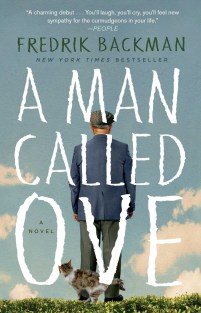 Fredrik Backman on:
 Britt-Marie:
 The classic Swedish picture books about triplets Snipp, Snapp and Snurr and Flicka, Ricka and Dicka:
 As a child, I thought of bridge as a mysterious game that parents played, in the afternoons when I was at school or in the evenings when I was in bed. The most complicated card games I knew were hearts, gin rummy, and cribbage. Recently, I became intrigued by the idea of bridge as mental exercise for my aging brain. My half-hearted attempt to learn the game met with failure, when the teacher at the community center recommended that I repeat the beginning course. This course was very basic; in fact, the teacher spent some time explaining that there are four suits in cards, two black and two red, and that the clubs look just like puppy paws.
 Pamela Wechsler, an attorney who spent many years as a criminal prosecutor in Boston and later became a consultant and writer for several TV shows, met the actor Billy Bob Thornton while she was a legal advisor on his movie, The Judge. Thornton — who won an Academy Award for writing the Sling Blade script — encouraged Wechsler to write a novel. The result is the page-turner Mission Hill, first in a planned series about Abby Endicott, a blue-blooded Boston prosecutor whose family expects her to join a white-shoe law firm but opts for the gritty world of criminal law. Thornton’s blurb is better than any description I could come up with: “Pam Wechsler delivers a thrill ride, crackling with suspense, wit and style. The story is rich, the characters are complex, and the writing is deft. I can’t wait for the next one.” I’m with Billy Bob! Watch for an interview with Wechsler on Books on the Table — but I warn you, the interview I just read on a website called
  Elizabeth J. Church, author of The Atomic Weight of Love, is also an attorney. Church, who’s published scholarly articles in legal and scientific journals as well as short stories, left the law after practicing for 30 years. She grew up in Los Alamos, New Mexico, the daughter of a research chemist who worked on the Manhattan Project during World War II. Church’s debut novel was inspired by the lives of her parents and their contemporaries. Meridian (Meri), a young biology student at the University of Chicago, marries her much older professor, Alden, and gives up her own dreams of becoming an ornithologist when her husband is sent to Los Alamos to help develop the atomic bomb. This lovely novel of love, sacrifice, and societal change spans 30 years in Meri and Alden’s flawed marriage. This would be a perfect book club selection — beautiful writing and plenty of issues to discuss. (Meri’s own experiences with women’s discussion groups are not very successful!)
 Squash champion Maria Toorpakai, author of the stunning memoir A Different Kind of Daughter: The Girl Who Hid From the Taliban in Plain Sight, risked her life to become a professional athlete. For over two years, death threats forced her to practice squash in her cement-walled bedroom. Born in Waziristan, the Taliban-dominated Federally Administered Tribal Area of northwest Pakistan, Toorpakai lived as a boy until she was sixteen. Her loving and liberal family supports her dream of athletic success, eventually allowing her to flee Pakistan and train with Jonathon Power, the world champion squash player who now runs the Power Squash Academy in Toronto. The human rights abuses that the Toorpakai vividly describes are numerous and shocking — as a young girl, is beaten by a mullah for showing an interest and athletics, and she sees a woman stoned to death. Don’t miss this powerful and inspiring memoir. I can’t wait to see Power’s documentary about Toorpakai’s s The War to Be Her, scheduled for release in September. (Special thanks to Aidan Harrison, squash pro at the Onwentsia Club in Lake Forest, Illinois and friend of Jonathon Power, who alerted me to Toorpakai’s amazing story.)
 April 23, 2016 marks the 400th anniversary of Shakespeare’s death. Historians believe that Shakespeare, in a bit of poetic serendipity, was also born on April 23. The Guardian lists some of the celebrations taking place worldwide:
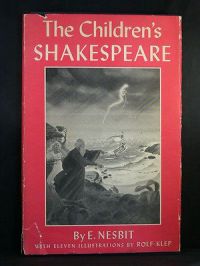 When I was eight or nine, someone gave me a book called The Children’s Shakespeare, by E. Nesbit (author of The Railway Children and many other classic children’s books) which summarizes each play in “words that little ones can understand”. In the introduction, Nesbit describes trying to read a A Midsummer NIght’s Dream to her young daughters, and having them complain they couldn’t understand the language:
 I can’t remember which Shakespeare play was the first one I ever saw, but I can tell you the first one in which I appeared — Macbeth. This is also the last Shakespeare play (or actually, any play) in which I’ve performed. My sixth grade teacher at Peck Elementary School, Mr. Baxter, assigned Macbeth to our class. He correctly guessed that sixth graders would love the violence, insanity, treachery, and witchcraft in the play. (E. Nesbit did not include Macbeth in The Children’s Shakespeare. She had a hard enough time with Romeo and Juliet’s suicides, failing to mention that Juliet stabs herself.) I recall a classroom discussion about why Macbeth killed Macduff’s innocent wife and young children:
 lthough I’m not much of a performer, I am an excellent audience member. Along with several dear friends, I’ve been a loyal subscriber to the Chicago Shakespeare Theater for many years. It’s a beautiful theater, built to evoke the design of the Globe Theater in London. No one throws rotten fruit at the stage as they supposedly did in Shakespeare’s time, although I once had the misfortune of being seated next to a heckler. (He didn’t care for Barbara Gaines’s modern interpretation of The Taming of the Shrew.
 The Underdogs: Children, Dogs, and the Power of Unconditional Love by Melissa Fay Greene
 Following Atticus: Forty-eight High Peaks, One Little Dog, and an Extraordinary Friendship by Tom Ryan
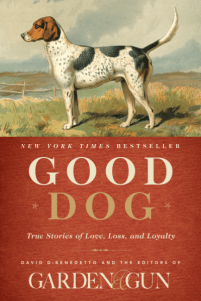 Good Dog: True Stories of Love, Loss, and Loyalty by David DiBenedetto and the editors of Garden & Gun
 Off the Leash: A Year at the Dog Park by Matthew Gilbert

 I stayed up way too late reading Lilac Girls, Martha Hall Kelly’s debut novel. Anyone who loved The Nightingale, Salt to the Sea, The Invisible Bridge, or All the Light We Cannot See will find this book both unforgettable and hard to put down. Historical fiction at its best, the novel tells the powerful story of female prisoners subjected to medical experimentation at the hands of the Nazis. Three narrators — a Polish teenager, a German doctor, and an American humanitarian, all based on real women, lend their distinctive voices to this meticulously researched story of heartbreak and courage.
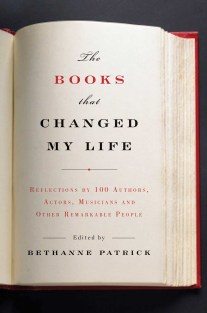 Like most book lovers, I adore books about books, and I thoroughly enjoyed Bethanne Patrick’s The Books That Changed My Life: Reflections by 100 Authors, Actors, Musicians, and Other Remarkable People. It’s a perfect book for your nightstand, because each of the essays is no more than three pages long. Each essay writer starts with a selection of a a life-altering book and a quotation from that book. They run the gamut from Gillian Flynn, who chose The Westing Game, to Rosanne Cash, who picked The Little House on the Prairie, to Tim Gunn, who selected Let Us Now Praise Famous Men. Bethanne Patrick says:
 We Never Asked for Wings by Vanessa Diffenbaugh (April 5)
 My Sunshine Away by M.O. Walsh (April 5)
 The Children’s Crusade by Ann Packer (April 5)
 Where They Found Her by Kimberly McCreight (April 19)
 Natural Born Heroes: Mastering the Lost Secrets of Strength and Endurance by Christopher McDougall (April 5)
 Between You and Me: Confessions of a Comma Queen by Mary Norris (April 4)
 Something Must Be Done About Prince Edward County: A Family, A Virginia Town, A Civil Rights Battle by Kristen Green (April 26)
 Since I was at the gate, not strapped into an airplane seat, I was able to move out of earshot of the impromptu concert, crossing my fingers that the young musicians would not be seated near me on the plane. I was really looking forward to finishing my book, Carly Simon’s memoir, Boys in the Trees.
 I did not have to sit near the harmonica-playing duo on the plane. Instead, I sat across from a young mother who had an infant in a front carrier and a two-year-old in the seat beside her. Both children fell asleep within 20 minutes of takeoff. (This never once happened to me, I want you know.) She ordered a Bloody Mary, settled back in her seat, opened her book (The Rosie Project, I couldn’t help but notice) and smiled at me. “Pure bliss, right?” I said to her.
 Margaret Sanger — nurse, birth control pioneer, social activist, free love advocate — led a big life. Too big to be contained in the pages of Ellen Feldman’s slim, fast-paced biographical novel, Terrible Virtue. I read Terrible Virtue in one afternoon, and although the book held me captive, it left me wanting more. Feldman races through Sanger’s long and eventful life, starting with her childhood as one of eleven siblings in a poor Irish Catholic family in upstate New York.
 Feldman presents Margaret Sanger not as a saint or a sinner, but as a complex, flawed visionary, driven not only by her passion for social justice and her vision of a better world, but by her own egotism. The reader feels both sympathy for the personal tragedy she endures and anger at her treatment of her family. Feldman, who tells most of the story from Margaret’s perspective, successfully uses short, straightforward sentences and an urgent tone to capture her voice. When Feldman breaks up Margaret’s narrative to include asides from other characters, addressed to Margaret, she is less successful. These sections, which don’t sound as though they are based on actual correspondence, are intended to add depth to Margaret’s portrayal, but they ring false to me.
 Books on the Table