It was like when you make a move in chess and just as you take your finger off the piece, you see the mistake you’ve made, and there’s this panic because you don’t know yet the scale of disaster you’ve left yourself open to.
Kazuo Ishiguro, Never Let Me GoNot only was it impossible to truly belong in America, but he didn’t fit in here anymore either. He was a dweller of two lands, accepted by none.
Shilpi Somaya Gowda, The Golden Son
 Anil Patel, the “golden son” in Shilpi Somaya Gowda’s insightful new novel, is torn between his desire to pursue an independent life and career in the United States and his obligations to his family and community in India. The story of an immigrant feeling untethered both in his adopted country and his native land is a familiar one, but The Golden Son offers a fresh perspective.
Anil, the eldest son of a prosperous landowner, is the first in his family to pursue higher education. As a child, he witnesses a baby girl, initially rejected by her parents because of a cleft palate, given “a smile as beautiful and perfect” as that of her siblings through the miracle of modern medicine — and through the efforts of Anil’s father, the wise village arbiter. Anil’s destiny is to become a doctor himself, as well as to follow in his father’s footsteps and negotiate all the disputes, minor and major, in his community.
As the successful eldest son in the family, Anil is unprepared for how inadequate he feels both in his roles as medical intern and village peacemaker. In an interview on “The Morning Show” on Canadian TV, Gowdi, the daughter of Indian immigrants, says her inspiration for the novel was her experience observing the tradition of the elder male as the family arbiter: “I thought it would be interesting to build a character who gets pulled into that type of role, perhaps when he’s not ready for it and doesn’t really want it.” In an interview with BookPage, she said:
I have long been intrigued by the Indian tradition of settling disputes within a community. I grew up hearing stories about lives that were changed: women granted divorces from abusive marriages, for example, before there were laws in place to protect them. Of course, not all disputes were settled happily, and afterward they had to go back to living together in the same community. It’s so different from the nearly anonymous, transactional way we administer justice.
The host of “The Morning Show” (who I doubt read the book) described The Golden Son as “‘Grey’s Anatomy’ meets ‘Slumdog Millionaire'”, which is a silly comparison because the only thing The Golden Son and “Slumdog Millionaire” have in common is that they both take place in India. However . . . fans of medical dramas (on screen or on the page) will love The Golden Son. The medical scenes, which take place in settings as varied as a busy inner-city emergency room, a high-tech cardiac catheterization lab and intensive care unit, the bedside of a cancer patient, and a makeshift clinic in a rural Indian village, are vivid and authentic. Gowda, who says she is “humbled by the nobility of the medical profession”, interviewed many patients and medical professionals as part of her research process. Her own father-in-law and brother-in-law are physicians.
When Anil begins a new life as a physician in the United States, he leaves behind not only his family, but his childhood friend, Leena. Her family, less prosperous than the Patels, arranges a marriage for her that turns out to be a colossal mistake. Gowda presents the story of Leena’s misfortunes as a parallel narrative to Anil’s story, building tension as the reader anticipates the moment when they come together.
The novel really develops momentum in the second half, as subplots involving Leena’s family and in-laws and Anil’s roommates, girlfriends, colleagues and supervisors all intertwine, with a surprising and satisfying ending. The novel both begins and ends with a chess game, with the game of chess as a metaphor for life recurring throughout the book. It’s not a subtle metaphor, but this isn’t an esoteric book. It’s a sincere, well-structured novel about, as the author notes, “the universal truths across cultures”.
 I also enjoyed Gowda’s bestselling debut novel, The Secret Daughter, about an Indian girl, adopted by an American couple, who decides to return to her birth country. A fascinating in-depth interview with Shilpi Somaya Gowda, in which she discusses both her novels, as well as her background growing up in two countries (Canada and India), her writing process, the status of women in India is available as a webcast on the Amnesty International Book Club website.
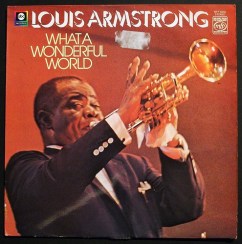 Most American cities name their airports for politicians (Reagan, JFK) or military heroes (Logan, O’Hare). Not New Orleans. The New Orleans airport is named after one of the 20th century’s most beloved musicians, Louis Armstrong — which signals to visitors that the city has a unique character. Tennessee Williams reportedly said, “America only has three cities: New York, San Francisco, and New Orleans. Everywhere else is Cleveland.”
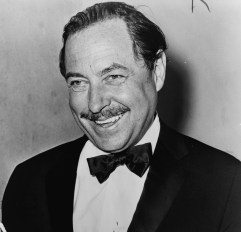 We left the subzero weather behind in “Cleveland” (which in our case was Chicago) last weekend and spent three days in Tennessee Williams’s adopted city. During our food tour, which included six stops at New Orleans restaurants, we saw the house in the French Quarter where Williams wrote A Streetcar Named Desire. (I don’t think the eight miles we walked that day came even close to burning the calories we consumed!) Kenneth Holditch, Ph.D., longtime friend of Williams, co-editor of the Library of America’s editions of Williams’s works, and the author of Tennessee Williams and the South, told the New Orleans Times-Picayune that “New Orleans was created by writers and visual artists . . . Sherwood Anderson once said this is a ‘city of imagination.’”
 For me, no vacation is complete without at least one bookstore visit. On our first day, we stumbled upon Beckham’s Bookshop in the French Quarter , which was everything a used bookstore should be — quirky, dusty, and packed with treasures. There was even a resident cat. My favorite section in the store was “True Crime and Rascality”. Because I’m unable to walk out of a bookstore without buying something, I picked up a copy of The House on First Street: My New Orleans Story, by Julia Reed. Reed, a journalist, got married and moved to the Garden District of New Orleans just before Hurricane Katrina struck. The New York Times critic, literary biographer Blake Bailey, gave the book a rave review despite his initial misgivings:
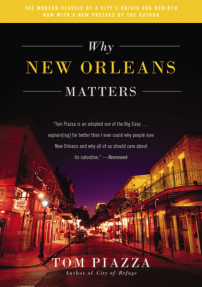 We rode the famous St. Charles streetcar to uptown New Orleans and visited a lovely independent bookstore, Octavia Books. I bought two more books: My New Orleans, Gone Away: A Memoir of Loss and Renewal, by Peter M. Wolf,and a signed copy of Why New Orleans Matters, by Tom Piazza. Piazza wrote his book in 2005, during “five agonizing weeks” following Hurricane Katrina. The updated edition, published in 2015, includes information about the city’s recovery. In the preface, Piazza says:
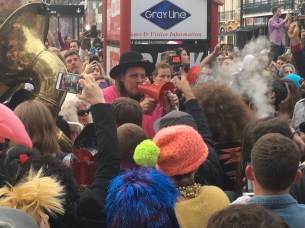 Thousands of adventurous people were in evidence on Saturday afternoon during the memorial parade for David Bowie. The parade, led by the Preservation Hall Jazz Band and Arcade Fire, was announced on social media just two days ahead of time but attracted Bowie fans and curiosity seekers from all over. Even though we didn’t have appropriate attire (space suits, tutus, gold lame), we jumped into the fray and followed the parade. At one point, we were just a few feet away from Win Butler of Arcade Fire, who was dressed in a hot pink suit and singing Bowie’s “Heroes”.
 John Kennedy Toole’s A Confederacy of Dunces, set in New Orleans, appears on Bowie’s list. I’ve never read this book, which is often referred to as a “cult classic” and won the Pulitzer Prize in 1981. Walker Percy said, “It is a great pity that John Kennedy Toole is not alive and well and writing. But he is not, and there is nothing we can do about it but make sure that this gargantuan tumultuous human tragi-comedy is at least made available to a world of readers.” If it weren’t for Percy, A Confederacy of Dunces would most likely never have been published. He was teaching at Loyola University in New Orleans when Toole’s mother brought him her late son’s novel. Percy championed the book, and Louisiana State University Press published it. The book was the first novel from an academic press to win a Pulitzer — beating out Percy’s novel, The Second Coming.
 Watson has selected Gloria Steinem’s memoir, My Life on the Road, for the first online discussion, scheduled to begin in a couple of weeks. (The exact date isn’t clear.) I’m not sure how the logistics of an online discussion with thousands of people will work, but kudos to Emma Watson for launching the club on January 6, choosing the first book on January 8, and attracting 84,000 enthusiastic participants less than a week later. I’m just glad I don’t have to supply the wine and cheese.
 I guess that building a robot would take away from my reading time, so I’ll stick with books. Zuckerberg’s reading list, with a few exceptions, looks pretty dreary to me — I’m not reading The Structure of Scientific Revolutions (a history of science published in 1970) anytime soon. Maybe Zuckerberg got burned out on reading because he didn’t include any fiction in the mix, except a work of science translated from the Chinese (The Three-Body Problem) whose title refers to the “three-body problem in orbital mechanics.” I did enjoy, and highly recommend, one of Zuckerberg’s picks — On Immunity: An Inoculation, by Eula Biss. This fascinating book, which defies categorization (science? sociology? memoir?) would be a great choice for real-life book clubs.
 Vogue magazine calls actress and producer Reese Witherspoon the “new patron saint of literature”. Witherspoon’s production company, Pacific Standard, produced film adaptations of Cheryl Strayed’s Wild and Gillian Flynn’s Gone Girl; current projects include movie versions of The Engagements (J. Courtney Sullivan) and Luckiest Girl Alive (Jessica Knoll) and a TV miniseries based on Big Little Lies (Liane Moriarty). According to Vogue:
 Bill Gates doesn’t have a book club, but he frequently posts reviews on his blog,
 When I checked to see which posts received the most views, I was surprised. The #1 post for 2015 is my
  #2:
#2:  #5:
#5:  #7:
#7:  #9:
#9:  Opera. It’s probably best I didn’t.
 Books on the Table