It’s one thing to write about the marrow of the bones — there’s a lot of research out there to back me up when I’m describing bones and blood and stem cells. It’s another thing to write about the marrow of the self. The marrow of the bones is home to your stem cells. The marrow of yourself is home to your soul.
Elizabeth Lesser, Marrow
When her sister, Maggie, is diagnosed with Stage IV lymphoma, Elizabeth Lesser learns that Maggie’s only chance for survival depends on a bone marrow transplant — and that Elizabeth is a perfect match. Marrow chronicles the sisters’ childhood and adult relationship, as well as the bone marrow transplant process.
Straddling the line between memoir and self-help and filled with both medical information and psychological insights, Marrow will appeal both to readers of Eat Pray Love and When Breath Becomes Air. I found Elizabeth Gilbert’s account of her solo travels boring and self-obsessed (although I loved her 2013 novel, The Signature of All Things), but I know Eat Pray Love struck a chord with many readers.
On the other hand, I absolutely loved — and will never forget — Paul Kalanathi’s gripping and beautiful memoir of his final days. Sad as it is, When Breath Becomes Air inspires the reader to live better, to be the best person he or she can be. Marrow may lack the stark and immediate power of When Breath Becomes Air — for one thing, the dominant voice is Elizabeth’s rather than Maggie’s; for another, the narrative frequently strays into territory that detracts from the central story of Maggie’s illness and the love between the two sisters — but in the end, it offers readers hope and inspiration.
When her second book, Broken Open: How Difficult Times Can Help Us Grow, Elizabeth didn’t expect her pragmatic sister “to even crack the book’s cover.” Maggie was “an avid reader, but her taste did not include anything that smacked of self-help. She liked novels or nonfiction books about beekeeping and bread baking.” (Maggie sounds like me, although my nonfiction tastes run to medical and historical topics, along with true crime.) However, Elizabeth notes that “there’s nothing like trauma to change one’s reading habits”, and she learned that Maggie had copied a passage from Broken Open and kept it on an index card in her car. In that passage, Elizabeth recounts that a psychic told her: “It is time for you to answer the call of your soul. It’s calling, but you’re too scared to listen. You think you know what’s important, but you don’t . . . What’s important in this life is to learn the soul lessons.”
I admit that when I start reading about psychics and soul lessons, I get a little skeptical. So it was a relief when I reached the chapter titled “Mother Cells”, in which Elizabeth describes reading a textbook called Essential Cell Biology and, in the simplest and clearest language, explains how a bone marrow transplant works: “The patient must endure a near-death experience in order to live.” The chapter ends with an entry from Maggie’s journal, in which she says, “I will try to proceed with good cheer.”
And, amazingly, she does just that, with the support of Elizabeth, their other sisters, her boyfriend, and their families. She gets fed up, as anyone would, with well-meaning friends who offer unsolicited advice about juice fasts, overseas clinics, and her “face twists into a look of wrathful disbelief when someone suggests that negative thinking, or grilled meat, or early exposure to pesticides might have caused the cancer.” An old friend suggests that if Maggie “refrains from using refined sugar and ingests large quantities of Japanese green tea she can totally heal from her disease.” Elizabeth offers readers some guidance on helping people who are sick:
Do not offer unsolicited advice . . . If you must, go ahead and ask them if they want to hear about promising new treatments or stories of those who beat the odds. Ask in such a way that the very vulnerable, very tired patient, or the equally weary caretaker, can easily say, “No, thank you” to articles, books, and links to treatment plans and meditative YouTube videos.
Many patients and caregivers roll their eyes at “inspirational” books filled with platitudes about positive thinking, but Marrow is not one of those. As I read, I grew to appreciate Elizabeth’s brave and honest approach to spirituality and self-discovery. Self-help books, she says, are not “superficial books that give pat answers to life’s unsolvable mysteries. They are “an ancient genre — the literature of wisdom, the philosophy of living.” (I even read one of the self-help books she recommends, The Four Agreements, which she says is “about the power of simple, honest, and bold communication.”)
Familiar books offer us consolation during difficult times. Elizabeth notes that the self-help books on her shelves give her strength and comfort, while her mother found that Walt Whitman provided solace and her father read Tolstoy repeatedly. I think that Marrow, a story about the strength of love, will be a book that many readers turn to again and again.
For an interesting interview with Elizabeth Lesser, check out this article in Psychology Today.
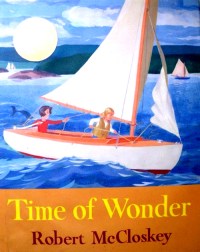 ate this lovely, poetic book as a child — like my own children, I much preferred Make Way for Ducklings and Blueberries for Sal — but now it’s my favorite McCloskey book. (And Robert McCloskey, along with E.B. White, is my favorite children’s author.)
 Isaac’s Storm: A Man, a Time, and the Deadliest Hurricane in History by Erik Larson
 Zeitoun by Dave Eggers
 Salvage the Bones by Jesmyn Ward
 A High Wind in Jamaica by Richard Hughes
 If I’m planning on reviewing a book, I try not to read any reviews until after I’ve posted my own thoughts. Not only do I find that many reviewers include too much information about the plot, I don’t want their opinions or language to influence mine. You would think that it’s possible to ignore what others have said about a book, but I find that words and phrases from other reviews burrow into my mind.
 The Perfect Horse: The Daring U.S. Mission to Rescue the Priceless Stallions Kidnapped by the Nazis by Elizabeth Letts
 All is Not Forgotten by Wendy Walker
 You Will Know Me by Megan Abbott
 We Could Be Beautiful by Swan Huntley
 Dog Gone: A Lost Pet’s Extraordinary Journey and the Family Who Brought Him Home by Pauls Toutonghi
 The Lost Girls by Heather Young
 The number one search term that’s led readers to Books on the Table over the past eighteen months is “Girl on the Train paperback release date”. That query led thousands of readers to a post from April 2015,
  A Window Opens by Elisabeth Egan
 Language Arts by Stephanie Kallos
 Crooked Heart by Lissa Evans
 The Hummingbird by Stephen P. Kiernan
 Every parent remembers listening politely (or at least pretending to listen) to their children’s long-winded plot descriptions of their favorite books, movies, or TV shows. As a grade schooler, my younger son had a more succinct way of conveying this information. He described everything in terms of its parentage. I asked him for some contemporary examples, and he offered these: If Lord of the Rings and The Sopranos had a baby, it would be Game of Thrones . . . if Jaws and the Sports Illustrated swimsuit edition had a baby, it would be The Shallows. (Is there a potential party game in this?)
 I just enjoy translating, it’s like opening one’s mouth and hearing someone else’s voice emerge.
 Confession: I’d never read anything by Neil Gaiman until last week, when I read his new collection of nonfiction pieces, The View from the Cheap Seats: Selected Nonfiction. Well, I read most of it. I admit to skimming the essays in Section II, “Some People I Have Known”, since they presupposed a certain amount of knowledge about influential science fiction and fantasy authors. The NPR reviewer calls the 550-page book a “hefty tome”, noting that Gaiman started as a journalist in the 1980s and that a complete collection of his nonfiction would “take up volumes”.
 Pamela Wechsler, an attorney who spent many years as a criminal prosecutor in Boston and later became a consultant and writer for several TV shows, met the actor Billy Bob Thornton while she was a legal advisor on his movie, The Judge. Thornton — who won an Academy Award for writing the Sling Blade script — encouraged Wechsler to write a novel. The result is the page-turner Mission Hill, first in a planned series about Abby Endicott, a blue-blooded Boston prosecutor whose family expects her to join a white-shoe law firm but opts for the gritty world of criminal law. Thornton’s blurb is better than any description I could come up with: “Pam Wechsler delivers a thrill ride, crackling with suspense, wit and style. The story is rich, the characters are complex, and the writing is deft. I can’t wait for the next one.” I’m with Billy Bob! Watch for an interview with Wechsler on Books on the Table — but I warn you, the interview I just read on a website called
  Elizabeth J. Church, author of The Atomic Weight of Love, is also an attorney. Church, who’s published scholarly articles in legal and scientific journals as well as short stories, left the law after practicing for 30 years. She grew up in Los Alamos, New Mexico, the daughter of a research chemist who worked on the Manhattan Project during World War II. Church’s debut novel was inspired by the lives of her parents and their contemporaries. Meridian (Meri), a young biology student at the University of Chicago, marries her much older professor, Alden, and gives up her own dreams of becoming an ornithologist when her husband is sent to Los Alamos to help develop the atomic bomb. This lovely novel of love, sacrifice, and societal change spans 30 years in Meri and Alden’s flawed marriage. This would be a perfect book club selection — beautiful writing and plenty of issues to discuss. (Meri’s own experiences with women’s discussion groups are not very successful!)
 Squash champion Maria Toorpakai, author of the stunning memoir A Different Kind of Daughter: The Girl Who Hid From the Taliban in Plain Sight, risked her life to become a professional athlete. For over two years, death threats forced her to practice squash in her cement-walled bedroom. Born in Waziristan, the Taliban-dominated Federally Administered Tribal Area of northwest Pakistan, Toorpakai lived as a boy until she was sixteen. Her loving and liberal family supports her dream of athletic success, eventually allowing her to flee Pakistan and train with Jonathon Power, the world champion squash player who now runs the Power Squash Academy in Toronto. The human rights abuses that the Toorpakai vividly describes are numerous and shocking — as a young girl, is beaten by a mullah for showing an interest and athletics, and she sees a woman stoned to death. Don’t miss this powerful and inspiring memoir. I can’t wait to see Power’s documentary about Toorpakai’s s The War to Be Her, scheduled for release in September. (Special thanks to Aidan Harrison, squash pro at the Onwentsia Club in Lake Forest, Illinois and friend of Jonathon Power, who alerted me to Toorpakai’s amazing story.)

 I stayed up way too late reading Lilac Girls, Martha Hall Kelly’s debut novel. Anyone who loved The Nightingale, Salt to the Sea, The Invisible Bridge, or All the Light We Cannot See will find this book both unforgettable and hard to put down. Historical fiction at its best, the novel tells the powerful story of female prisoners subjected to medical experimentation at the hands of the Nazis. Three narrators — a Polish teenager, a German doctor, and an American humanitarian, all based on real women, lend their distinctive voices to this meticulously researched story of heartbreak and courage.
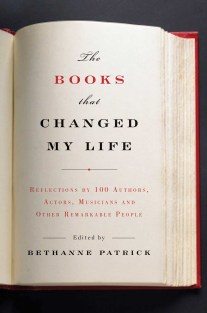 Like most book lovers, I adore books about books, and I thoroughly enjoyed Bethanne Patrick’s The Books That Changed My Life: Reflections by 100 Authors, Actors, Musicians, and Other Remarkable People. It’s a perfect book for your nightstand, because each of the essays is no more than three pages long. Each essay writer starts with a selection of a a life-altering book and a quotation from that book. They run the gamut from Gillian Flynn, who chose The Westing Game, to Rosanne Cash, who picked The Little House on the Prairie, to Tim Gunn, who selected Let Us Now Praise Famous Men. Bethanne Patrick says:
 Books on the Table