If we stop writing letters, who will keep our history or dare venture upon a biography? George Washington, Oscar Wilde, T.E. Lawrence, Virginia Woolf, Oliver Wendell Holmes, E.B. White, Vera Nabokov, J.P. Morgan — if any of these vivid predecessors still belong to us in some fragmented private way, it’s because of their letters or diaries (which are letters to ourselves) or thanks to some strong biography built on a ledge of letters.
Roger Angell, This Old Man: All in Pieces
Dear Fellow Bookworms,
When I was in grade school, I learned to write what was called the Friendly Letter. The Friendly Letter always included the Complimentary Close — “Yours truly”, “Your friend”, “Sincerely”, or “Love”. (Mrs. Pierce, my third grade teacher, warned us only to use “Love” when writing to a family member.) There are dozens of ways to end a letter, from the ubiquitous “Best”, (best what? I always wonder),”Fondly”, “Regards”, to the more elaborate closings of days gone by. Paul’s letter to the Colossians, for example, ends this way: “This salutation by my own hand–Paul. Remember my chains. Grace be with you. Amen.” Thomas Jefferson popularized the closing, “Your most humble and most obedient servant”. Charles Dickens often closed personal letters with the charming phrases “Ever your affectionate friend” or “Yours heartily and affectionately”.
 Mina Harker, one of Dracula’s victims, closes her letters by saying “Your ever-loving Mina Harker.” Frankenstein’s ill-fated fiancée, Elizabeth Lavenza, ends a letter with “Adieu! Take care of yourself, and I entreat you, write!”. What do these two characters have in common? They both appear in epistolary novels, books written either entirely or mostly in letters.
When you read a good epistolary novel, you have a sense of immediacy and realism that’s usually not found in a book narrated in the first or third person. You feel as though you’ve stumbled upon a cache of private letters. I think the first novel of this type I read was Daddy-Long-Legs by Jean Webster, published in 1912. It’s the story of a young girl raised in an orphanage who, through the help of a mysterious benefactor with whom she corresponds, is able to attend college. Katherine Reay wrote an absolutely delightful, and award-winning novel, Dear Mr. Knightley, which is a modern version of the Daddy-Long-Legs story.
Over the years, many of my favorite novels have been based on letters:
- Alice Walker’s modern classic, The Color Purple, tells Celie’s story through her letters to God.
- The Guernsey Literary and Potato Peel Society (by Mary Ann Shaffer and Annie Barrows, aunt and niece) is a series of letters from a London writer to the inhabitants of the island of Guernsey.
- In Jessica Brockmole’s Letters from Skye, a young poet from the remote Isle of Skye receives a fan letter from an American student, and their correspondence turns into a complicated love affair.
- Marilyn Robinson’s beautiful Pulitzer Prize-winning novel, Gilead, is a letter from a dying minister to his young son.
- Carlene Bauer based Frances and Bernard on letters between poet Robert Lowell and novelist and short story writer Flannery O’Connor. Like Gilead, this novel is concerned with the characters’ spiritual lives.
- In Where’d You Go, Bernadette, a brilliant teenager tries to track down her missing mother — and Maria Semple used letters, emails, blog posts, notes, and interview transcripts involving a wacky cast of characters to show just how she does that.
- Julie Schumacher cleverly assembled a hilarious novel made up solely of recommendation letters that a beleaguered English professor is constantly called upon to write in Dear Committee Members.
- Code Name Verity, a YA novel by Elizabeth Wein, is the gripping story of two young British women captured in occupied France during World War II, told through the “confessions” they write to their interrogators.
- A completely different YA novel, The Perks of Being a Wallflower (by Stephen Chbosky) is a coming-of-age story consisting of letters from a shy and precocious teenager to an unnamed recipient.
 Of course, sometimes only real letters will do. I treasure several anthologies of letters from both famous and ordinary people. War Letters: Extraordinary Correspondence from American Wars (edited by Andrew Carroll) and Letters of Note: An Eclectic Collection of Correspondence Deserving of a Wider Audience (edited by Shaun Usher). Volume 2 of Letters of Note just came out last month, and I’m savoring every letter. My all-time favorite epistolary book is Helene Hanff’s 84, Charing Cross Road (which, surprisingly, was made into a movie that does justice to the book), which chronicles a 20-year correspondence between Hanff, a writer in New York, and Frank Doel, an antiquarian bookseller in London. Another favorite is My Dearest Friend: Letters of Abigail and John Adams, which contains just a fraction of the 1,100 letters that the couple wrote to each other during the many separations they endured over the course of their 54-year marriage. Their letters bring the world of this country’s founders alive more than any other surviving documents.
 In a recent book called Signed, Sealed, Delivered: Celebrating the Joys of Letter Writing, Nina Sankovitch describes finding a trunk filled with hundreds of letters in a shed attached to a house her family was renovating in the Upper West Side of New York. The letters belonged to the original owners of the home, the Seligman family, and the vast majority of them were written by James Seligman to his parents (whom he addressed as “Dearest Mamma” or “Darling Parents”) during his years at Princeton, 1908-1912. Nina feels that rereading the letters James left behind “proves all over again, the power of the written, the handwritten, word.” Aside from a listing on an online family tree, James left no other evidence of his life. Nina says:
Paper and ink have created a lasting connection between James and me. The connection has made me a better person, if only for having laughed so much and indulged in so much pleasurable company through his letter. And isn’t that what we say about our friends, that they have enriched our lives and made us better people?
Ever your affectionate friend,
Ann @ Books on the Table
 It’s one thing to write about the marrow of the bones — there’s a lot of research out there to back me up when I’m describing bones and blood and stem cells. It’s another thing to write about the marrow of the self. The marrow of the bones is home to your stem cells. The marrow of yourself is home to your soul.
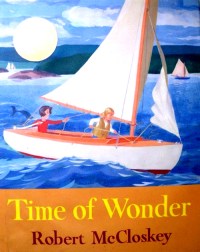 ate this lovely, poetic book as a child — like my own children, I much preferred Make Way for Ducklings and Blueberries for Sal — but now it’s my favorite McCloskey book. (And Robert McCloskey, along with E.B. White, is my favorite children’s author.)
 Isaac’s Storm: A Man, a Time, and the Deadliest Hurricane in History by Erik Larson
 Zeitoun by Dave Eggers
 Salvage the Bones by Jesmyn Ward
 A High Wind in Jamaica by Richard Hughes
 The number one search term that’s led readers to Books on the Table over the past eighteen months is “Girl on the Train paperback release date”. That query led thousands of readers to a post from April 2015,
  A Window Opens by Elisabeth Egan
 Language Arts by Stephanie Kallos
 Crooked Heart by Lissa Evans
 The Hummingbird by Stephen P. Kiernan
 Confession: I’d never read anything by Neil Gaiman until last week, when I read his new collection of nonfiction pieces, The View from the Cheap Seats: Selected Nonfiction. Well, I read most of it. I admit to skimming the essays in Section II, “Some People I Have Known”, since they presupposed a certain amount of knowledge about influential science fiction and fantasy authors. The NPR reviewer calls the 550-page book a “hefty tome”, noting that Gaiman started as a journalist in the 1980s and that a complete collection of his nonfiction would “take up volumes”.
 More than 500 authors are on hand to sign their books, and attendees queue up — sometimes for hours — to meet their favorite authors and receive personally inscribed books. I don’t have the patience to stand in line for much of anything, unless I’m forced to wait in a TSA line at the airport, so I didn’t get any signed books. If I were less antsy, I would have enjoyed meeting Candice Millard (signing Hero of the Empire: The Boer War, a Daring Escape, and the Making of Winston Churchill, coming in September), Jonathan Safran Foer (signing Here I Am, due in September and his first novel since Extremely Loud and Incredibly Close in 2005), Emma Cline (signing The Girls, her debut novel, which is the #1 Indie Pick for June), Amor Towles, author of Rules of Civility (signing A Gentleman in Moscow, out in September), Richard Russo (signing Everybody’s Fool, his follow-up to Nobody’s Fool), and dozens of others.
 OK, point taken. I’m not a book hoarder or a bibliomaniac — but I do have a hard time culling my bookshelves. (For more on my difficulties in this area, see
  She just smiled, said that she loved books more than anything, and started telling him excitedly what each of the ones in her lap was about. And Ove realised that he wanted to hear her talking about the things she loved for the rest of his life.
 Fredrik’s novels, bestsellers in Sweden, the United States, and dozens of other countries, hit the sweet spot for readers looking for fiction that’s charming, humorous, and a bit quirky — but not corny. They’re the kind of books that people fall in love with and give to all their friends. One of Fredrik’s editors told Publishers Weekly: “I think Fredrik is different from the dark crime writers and doing something different from writers in general . . . He has such a distinctive voice and point of view. He might be the herald of a larger trend in Scandinavian literature, but I think he’s doing his own thing.”
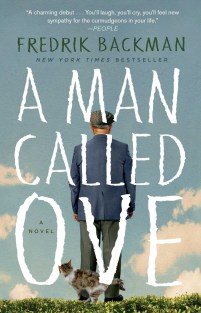 Fredrik Backman on:
 Britt-Marie:
 The classic Swedish picture books about triplets Snipp, Snapp and Snurr and Flicka, Ricka and Dicka:
 As a child, I thought of bridge as a mysterious game that parents played, in the afternoons when I was at school or in the evenings when I was in bed. The most complicated card games I knew were hearts, gin rummy, and cribbage. Recently, I became intrigued by the idea of bridge as mental exercise for my aging brain. My half-hearted attempt to learn the game met with failure, when the teacher at the community center recommended that I repeat the beginning course. This course was very basic; in fact, the teacher spent some time explaining that there are four suits in cards, two black and two red, and that the clubs look just like puppy paws.
 Pamela Wechsler, an attorney who spent many years as a criminal prosecutor in Boston and later became a consultant and writer for several TV shows, met the actor Billy Bob Thornton while she was a legal advisor on his movie, The Judge. Thornton — who won an Academy Award for writing the Sling Blade script — encouraged Wechsler to write a novel. The result is the page-turner Mission Hill, first in a planned series about Abby Endicott, a blue-blooded Boston prosecutor whose family expects her to join a white-shoe law firm but opts for the gritty world of criminal law. Thornton’s blurb is better than any description I could come up with: “Pam Wechsler delivers a thrill ride, crackling with suspense, wit and style. The story is rich, the characters are complex, and the writing is deft. I can’t wait for the next one.” I’m with Billy Bob! Watch for an interview with Wechsler on Books on the Table — but I warn you, the interview I just read on a website called
  Elizabeth J. Church, author of The Atomic Weight of Love, is also an attorney. Church, who’s published scholarly articles in legal and scientific journals as well as short stories, left the law after practicing for 30 years. She grew up in Los Alamos, New Mexico, the daughter of a research chemist who worked on the Manhattan Project during World War II. Church’s debut novel was inspired by the lives of her parents and their contemporaries. Meridian (Meri), a young biology student at the University of Chicago, marries her much older professor, Alden, and gives up her own dreams of becoming an ornithologist when her husband is sent to Los Alamos to help develop the atomic bomb. This lovely novel of love, sacrifice, and societal change spans 30 years in Meri and Alden’s flawed marriage. This would be a perfect book club selection — beautiful writing and plenty of issues to discuss. (Meri’s own experiences with women’s discussion groups are not very successful!)
 Squash champion Maria Toorpakai, author of the stunning memoir A Different Kind of Daughter: The Girl Who Hid From the Taliban in Plain Sight, risked her life to become a professional athlete. For over two years, death threats forced her to practice squash in her cement-walled bedroom. Born in Waziristan, the Taliban-dominated Federally Administered Tribal Area of northwest Pakistan, Toorpakai lived as a boy until she was sixteen. Her loving and liberal family supports her dream of athletic success, eventually allowing her to flee Pakistan and train with Jonathon Power, the world champion squash player who now runs the Power Squash Academy in Toronto. The human rights abuses that the Toorpakai vividly describes are numerous and shocking — as a young girl, is beaten by a mullah for showing an interest and athletics, and she sees a woman stoned to death. Don’t miss this powerful and inspiring memoir. I can’t wait to see Power’s documentary about Toorpakai’s s The War to Be Her, scheduled for release in September. (Special thanks to Aidan Harrison, squash pro at the Onwentsia Club in Lake Forest, Illinois and friend of Jonathon Power, who alerted me to Toorpakai’s amazing story.)
 The Underdogs: Children, Dogs, and the Power of Unconditional Love by Melissa Fay Greene
 Following Atticus: Forty-eight High Peaks, One Little Dog, and an Extraordinary Friendship by Tom Ryan
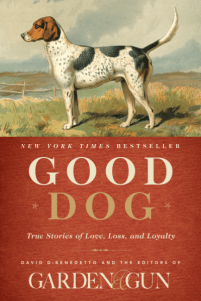 Good Dog: True Stories of Love, Loss, and Loyalty by David DiBenedetto and the editors of Garden & Gun
 Off the Leash: A Year at the Dog Park by Matthew Gilbert
 Books on the Table