10 Books for “Carnivorous” Readers

Is anyone else really, really tired of the term “curated”? To quote from the Chowhound website: “You curate a museum, or perhaps an art collection for a billionaire”. I agree — restaurants don’t “curate” wine lists, and book reviewers don’t “curate” lists of books. I promise never to use that annoying word in this blog! What I will do is present a list of books that my oldest son liked a lot. Today is David’s 27th birthday, so of course I bought him a book. (I also bought him a plane ticket, but he’ll need something to read on the plane, right?) I started thinking about David’s evolution as a reader, from Richard Scarry’s Cars and Trucks and Things That Go, to the DK Eyewitness Pond and River LIfe, to Rick Reilly’s Who’s Your Caddy?.

To make a silly analogy to the animal kingdom, readers can be divided into three categories: herbivores (fiction readers), carnivores (nonfiction readers), and omnivores (people who read anything). David, like so many of his gender, is a carnivore. Even as a young child, he preferred the fact-oriented series The Magic Schoolbus to its fictional cousin, the Magic Tree House series. (Although he loved Jon Scieszka’s  books about the Time Warp Trio — it must have been the humor. I’ve found, as a bookseller and a parent, that if a book is funny a little boy will like it.)

coverSo is it any surprise that a book David recently enjoyed, and recommends to other carnivores, is called Meat Eater? It’s written by journalist Steven Rinella, also the author of American Buffalo: A Lost Icon. But don’t take David’s word for it. Here’s what the New York Times and Wall Street Journal had to say about the book:

The stories in Meat Eater are full of empathy and intelligence….In some sections of the book, the author’s prose is so engrossing, so riveting, that it matches, punch for punch, the best sports writing. When Mr. Rinella wades into the surging Grand River, to throw a fly for steelheads, the story moves as well as Tom Callahan writing about Johnny Unitas in the 1958 championship or Bill Nack writing about Secretariat. — Wall Street Journal

Truth be told, I have lived a life plenty comfortable with my disdain toward hunters and hunting. And then along comes Steven Rinella and his revelatory memoir Meat Eater to ruin everything. Unless you count the eternal pursuit of the unmetered parking space, I am not a hunter. I am, however, on a constant quest for good writing. . . This is survival of the most literate. —New York Times

If you’re a carnivore, or know someone who is, here are a few other suggestions from David’s library (both his childhood library and his current bookshelves):

Harris and Me (Gary Paulsen)
All Paulsen’s books are wonderful, but this one is special. It’s about a city boy who spends the summer on his cousin’s farm. There are many hilarious incidents, with just the right amount of crude humor to appeal to grade school age boys. It’s fiction — as are many of Paulsen’s other books (including the Hatchet series) — but still good for carnivores.
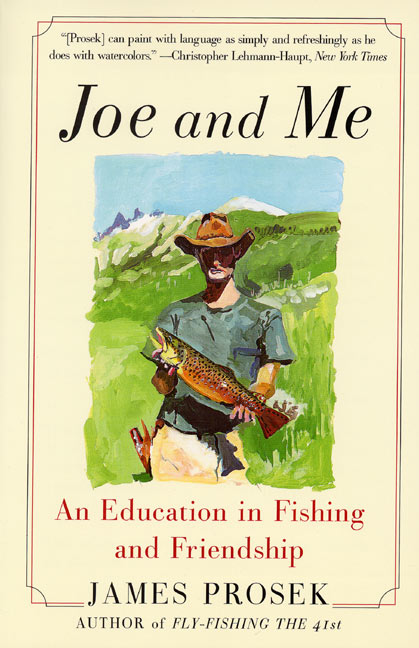
9780060537845Joe and Me: An Education in Fishing and Friendship  (James Prosek)
A coming of age story about a teenage boy who runs afoul of the local fish and game warden. David’s copy looks like it’s been read a few times. Prosek has written many other terrific books about fly fishing, but this is the only one for YA readers.

Who’s Your Caddy?: Looping for the Great, Near Great, and Reprobates of Golf (Rick Reilly)
I think I enjoyed this book as much as David did, and I don’t even follow golf. Reilly has to be a great writer if he can get me to read a golf book. I started reading it because I was slightly worried about the content, and then got hooked. (Looking back, I can’t believe I was worried about what a sophomore in high school was reading. Can you tell David is my oldest?)

Into Thin Air: A Personal Account of the Mount Everest Disaster (Jon Krakauer)
A classic adventure story about an ill-fated ascent of Mount Everest in 1996. Krakauer’s Into the Wild is excellent as well.

The Psychopath Test: A Journey Through the Madness Industry (Jon Ronson)
Our whole family passed this book around on vacation a couple of summers ago — it’s fascinating!  What a relief it was to find that none of us is a psychopath.

Methland: The Death and Life of an American Small Town (Nick Reding)
Journalist Reding spent four years in a small town in Oelwein, Iowa, examining the effects of the meth epidemic on that town and similar towns all over the Midwest. My daughter and I couldn’t put this book down either.

9780393081817_300Boomerang: Travels in the New Third World (Michael Lewis)
It seems that Michael Lewis can do no wrong — his books, starting with Liar’s Poker (another favorite of David’s) — are uniformly excellent, transforming complicated economics into entertaining and informative narratives.

No Easy Day: A Firsthand Account of the Mission That Killed Osama Bin Laden (Mark Owen)
The movie Zero Dark Thirty tells a little bit of the story; this book, written by a Navy SEAL,  provides all the details. Apparently the author (who used a pseudonym) was criticized for revealing secrets without clearance from the government.

An American Caddie in St. Andrews: Growing Up, Girls, and Looping on the Old Course (Oliver Horovitz)
An American teenager spends a “gap year” in Scotland as a caddy at the world’s most famous golf course — and returns to work there year after year, even after college graduation.

Guess where we are going to celebrate David’s birthday tonight? A hot new barbecue restaurant in Chicago — Green Street Smoked Meats*. And I hope he likes the book I’m giving him: The Price of Silence: The Duke Lacrosse Scandal, the Power of the Elite, and the Corruption of Our Great Universities, by Bill Cohan. It just got a rave review in the New York Times.

*Thank you, Gina, for organizing!


10 Gateway Books for Teenagers

I have to admit that I’m not a YA reader. I would like to be, but there are only so many reading hours in the day, and my list of Old Adult fiction and nonfiction just keeps growing. I know that YA is a huge phenomenon in the publishing world, and I need to learn more about it.

What exactly is YA? That’s the question that I saw on Twitter a few days ago. Someone else asked, “Is Tell the Wolves I’m Home YA”? Multiple people responded, all with variations on the same answer: “No, it’s coming-of-age”.  What is the difference? My guess is that YA fiction is written with a teenage audience in mind, whereas literary fiction isn’t targeted toward a particular demographic group. The recent phenomenon of adults reading YA is fascinating to me. Does it reflect our youth-oriented culture in general? When I was a teenager, I was more interested in reading “up” than my mother was in reading “down”. She didn’t cvr9781416914631_9781416914631_lgread my copies of Forever and Go Ask Alice, but I did read her copies of The Godfather and Ordinary People. (Then again, I was more interested in borrowing her clothes than she was in wearing mine. I think mothers today aspire to dress like their daughters.)

Now parents are borrowing their children’s copies of Divergent and Twilight, or even buying those series for themselves. Certain books are “crossover” novels, published as YA in one country and adult in another. The Curious Incident of the Dog in the Night-Time  (Mark Haddon) and The Boy in the Striped Pajamas (John Boyne) were marketed as YA in Great Britain and adult in the United States, while The Book Thief (Marcus Zusak), sold as YA here, was originally published as an adult book in Australia.

9780062225443When customers ask me for books that will appeal to their teenagers but are not “YA” books, I have some tried-and-true favorites I suggest. You could think of these as “gateway” books to grown-up literature. (Back when I was reading Go Ask Alice, marijuana was considered the “gateway” drug to heroin. Now you can legally buy marijuana in Colorado!) Often, the customer will say, “Oh! I have a copy of The Secret Life of Bees (or The Help, or Into Thin Air) at home . . . maybe he/she would like that.” Here are 10+ other books that appeal to young people:

Durable Goods, Joy School, and True to Form by Elizabeth Berg: A trio of books about army brat Katie Nash, growing up with an abusive father.

Unbroken by Laura Hillenbrand: Still in hardcover more than 3 years after publication! Teenagers are amazed and inspired by Louie Zamperini’s story. Have them read it before the movie comes out.

cover-1The Bean Trees and Pigs in Heaven by Barbara Kingsolver: Two books about spirited adventurer Taylor Greer and her adopted Cherokee daughter, Turtle.

Reconstructing Amelia by Kimberly McCreight: Page-turner about a mother investigating her teenage daughter’s apparent suicide.

The Pact (or anything, really) by Jodi Picoult: No need to elaborate. Teenagers love Jodi.

Who’s Your Caddy: Looping for the Great, Near Great, and Reprobates of Golf by Rick Reilly (his new book, out in May — Tiger, Meet My Sister . . . And Other Things I Probably Shouldn’t Have Said sounds like it will be perfect for older teenagers too): Sports Illustrated writer Reilly has written many very insightful and funny golf books.

37333cb0909ab45f2302dcbb83df4127The Yonalohssee Riding Camp for Girls by Anton DiSclafani: Who doesn’t love a boarding school book? This one is set in the 1930s, at a school for equestriennes in the mountains of North Carolina.

Me Talk Pretty One Day (or anything except Squirrel Seeks Chipmunk) by David Sedaris: Hilarious, and even better on audio.

Maus and Maus II by Art Spiegelman: Graphic novels of the Holocaust.

Old School by Tobias Wolff: Another boarding school novel; this one has a cameo appearance by Robert Frost.

What are your favorite gateway books for teenagers?


A Cautionary Tale

IMG_0318When I was a brand new bookseller, a customer asked me how many books she should bring on her upcoming five-day vacation. I told her I would bring five books. She looked aghast, so I quickly told her that I knew I wouldn’t actually read that many books. Several of my books are insurance — what if the flight is delayed, finally boards, then sits on the runway for an hour waiting to take off, and then, when it arrives at its destination, sits on the tarmac for an hour waiting for a gate? What if the flight circles the airport forever and finally is diverted to another airport, from which I have to take a bus to my home airport? What if one of the books is a huge disappointment? My mother was once waiting for a connection in an airport and started reading a book that turned out to be so awful she left it at the gate. It was a hardcover book, and she couldn’t bear to throw it out, even though it was unreadable.

After the customer left the store (with a bag of four books), Sue, who was trying to train me in the art of bookselling, told me that most people probably wouldn’t bring one book for every day of a trip. I explained to her my ideas about insurance, and also mentioned that I thought the customer’s question was rather odd. She was a complete stranger to me; how could I possibly know how voracious a reader she was? This was just the first of many unusual questions from customers I’ve tried to answer. The trick, as I now know, is to answer the question with a question: “How many books did you bring on your last trip? How did that work for you?”

Flash forward almost 16 years. Sue sold Lake Forest Book Store and moved to Glen Arbor, Michigan, where she’s now the owner of the Cottage Book Shop. After surviving her first winter in the Snow Belt, she went with her daughter to visit friends in sunny Arizona. I was on vacation at the same time and Sue and I exchanged a few texts about what we were reading. (She highly recommends Herman Koch’s upcoming book, Summer House with Swimming Pool.) Then I received this text: “I’ve read all my physical books. Should have brought more.” She didn’t bring any insurance. Sue had anticipated more activity and less reading time on this trip.

cvr9781451621389_9781451621389_lgSue downloaded some books from Edelweiss on her IPad. (Edelweiss is a service that allows booksellers, reviewers, librarians, etc. to download free advance readers’ copies.) But, she told me, she doesn’t read on her IPad out of the house. She wants to present a good example to the reading public. So Sue ended up buying a book at full retail price at the airport bookstore. The book was Brain on Fire: My Month of Madness, by Susannah Cahalan, and Sue says it was well worth the price. Still, maybe next time she will bring an extra book (or two) . . . just in case.

You would think that, with the advent of e-books, I wouldn’t feel the need to pack extra books. I am perfectly willing to read my IPad in public, although I confess to walking down the aisle of the airplane and taking a quick poll of how many people are reading real books. (According to a recent Pew research study, last year 70% of American adults read at least one physical book and 28% read an e-book, compared with 66% and 23% in 2012.) I will always prefer turning the pages of a book. And I can’t rely on my IPad . .  what if it malfunctions, or the battery dies and there’s nowhere to recharge it? So I keep stuffing one more book in my carry-on, because you never know what could happen.

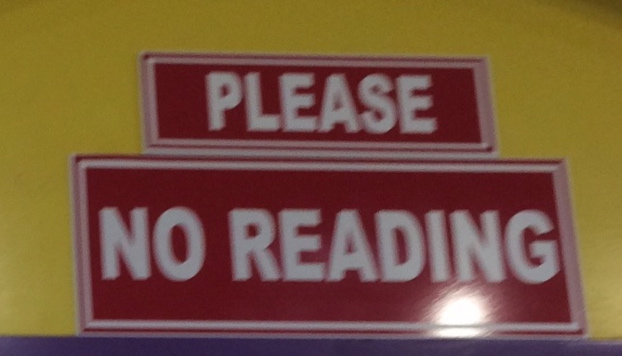
ImageThank goodness for airport bookstores! I always like to pick up a magazine or two before a flight. Recently, however, I visited the most inhospitable airport convenience store ever. This one couldn’t possibly be called a bookstore, because it had only a few dusty paperbacks and a very limited selection of magazines. Posted over the sad little magazine and book display was a sign that said, ” PLEASE NO READING”. I found this amusing, and snapped a photo — only to be escorted out of the store by the very unamused manager. What if I had run out of reading material and really needed to buy some? What would I have done then?

9781250037756In case you’re wondering what else Sue read (besides Summer House with Swimming Pool and Brain on Fire), she finished Mr. Penumbra’s 24-Hour Bookstore by Robin Sloan (“quirky”) and Essentialism by Greg McKeown (“read it straight through”), and started The Steady Running of the Hour by Justin Go. I read Essentialism as well, and can’t wait to tell you more about it in a couple of weeks — the publication date is April 15.

For more of my thoughts on bringing extra books on trips, check out an earlier post: Leaving on a Jet Plane. Maybe I’ve exhausted this topic, but I just hate to think of a reader stranded without a good book.

STLFeature150

Favorite Irish Authors: Tellers of Tales

Circa 1980; my copy of the Selected Poems of W.B. Yeats

Let us go forth, the tellers of tales, and seize whatever prey the heart longs for, and have no fear. Everything exists, everything is true, and the earth is only a little dust under our feet.
William Butler Yeats, The Celtic Twilight: Faerie and Folklore

Forget the green beer, McDonald’s Shamrock Shakes, and buttons that say, “Kiss Me, I’m Irish”. Let’s celebrate one of Ireland’s greatest contributions to the world: its authors. Yeats, of course (my favorite poet of all time), James Joyce, Oscar Wilde, George Bernard Shaw, Samuel Beckett . . . all giants of literature, studied by every English major. I have to admit that although I loved Joyce’s Dubliners and  Portrait of the Artist as a Young Man, I struggled with Ulysses. I’m pretty sure I skulked into the college bookstore, looking for the CliffsNotes on the revolving wire rack tucked into the back corner.

TheWindingStair001A few years ago, Jeff and I visited Dublin for a few days. It was a perfect trip for a history buff (Jeff) and a literature lover (me).  We explored the Dublin Writers’ Museum, saw the Joyce statue on O’Connell Street, waited in line to see the Book of Kells at Trinity College, toured Kilmainham Gaol (Jeff’s idea, not mine), went to several plays, and stopped by more than our share of pubs. (We didn’t, however, retrace Leopold Bloom’s route through the city on the guided walk offered by the Joyce Cultural Centre. ) As someone who relied on the CliffsNotes to get through Ulysses, I didn’t feel entitled to take that tour!) We did have dinner at the Winding Stair on the River Liffey. Downstairs is one of the oldest independent bookshops in Dublin and upstairs is a restaurant serving “good, old-fashioned home cooking”.

Life is a journey up a spiral staircase; as we grow older we cover the ground we have covered before, only higher up; as we look down the winding stair below us we measure our progress by the number of places where we were but no longer are. The journey is both repetitious and progressive; we go both round and upward.
William Butler Yeats

9780143113492HI always like to read something about the place I’m visiting, so on the flight to Dublin I read In the Woods by Tana French. It’s a murder mystery/psychological thriller, featuring  two detectives from the Dublin Murder Squad trying to solve two murders that have taken place 20 years apart. I’m not usually much of a mystery reader, but this one captivated me because of the gorgeous writing and the evocation of modern Ireland, in addition to the complex puzzle of two parallel crimes. One of those crimes is never solved; this is not a formulaic mystery. In an interview, Tana French describes her favorite mystery novels:

. . . the ones that experiment with the boundaries of the genre: Donna Tartt’s The Secret History (which is both my favorite literary novel and my favorite crime novel), where you find out on the first page who killed whom; Josephine Tey’s The Franchise Affair, a deeply unsettling study of a psychopath, where the villain is obvious almost from the start and the most serious crime is basically wasting police time; Dennis Lehane’s Mystic River, where the guilty go free and the innocent pay for others’ crimes.

French has written three other Dublin Murder Squad novels: The Likeness, Faithful Place, and Broken Harbor. Each one is narrated by a different detective, and each one touches on Irish themes — from the “Celtic Tiger” and the recession that followed to the country’s folklore and medieval history. They are, according to the New York Times, “brilliant and satisfying novels about memory, identity, loss, and what defines us as humans.” If you’re lucky enough to take a trip to Dublin, I highly recommend taking a Tana French novel or two along.

9780143035091HIf I had to choose a favorite Irish author, it would be Sebastian Barry. When you read one of his novels, you know you are reading the work of a poet. (Barry is in fact the author of two collections of poetry and numerous plays, in addition to eight novels.) The New York Times says, “Mr. Barry has said that his novels and plays often begin as poems . . . but his language never clots the flow of his story; it never gives off a whiff of labor and strain. It is like a song, with all the pulse of the Irish language, a song sung liltingly and plaintively from the top of Ben Bulben into the airy night.” You can choose at random almost any passage from any one of his novels and be struck by the beauty of the language, but here’s one of my favorites, from A Long Long Way:

Such a singing voice he had. His mother, who was a blunt woman enough, one of the Cullens herself, daughter of the coppicer on the Humewood estate in Wicklow, got only good from it. She set him on a chair to sing like any woman might, and he threw his small head back and sang some song of the Wicklow districts, as might be, and she saw in her mind a hundred things, of childhood, rivers, woods, and felt herself in those minutes to be a girl again, living, breathing, complete. And wondered in her private mind at the power of mere words, the mere things you rolled round in your mouth, the power of them strung together on the penny string of a song, how they seemed to call up a hundred vanished scenes, gone faces, lost instances of human love.

Willie Dunne, the protagonist of A Long Long Way, who has such a beautiful singing voice as a child, ends up going to France when World War I breaks out in 1914, and fighting against his own people in the Easter Uprising of 1916. The Dunne family appears again and again in Barry’s novels. Willie is the brother of Annie Dunne, who is the title character of an earlier novel, and of Lily Bere, who is the main character in On Canaan’s Side. Similarly, The Trial of Eneas McNulty, The Secret Scripture, and the upcoming The Temporary Gentleman all focus on members of the McNulty family. Read as a whole, Barry’s novels cover the Irish experience of the entire 20th century. In interview with the Guardian, Barry says, “I am trying to rescue my characters from the cold hand of history, and from the silences that surround certain turbulent periods in our own history.”

The Irish tradition of oral storytelling continues to influence today’s Irish writers. The Guardian says, “Language remains, for Barry, something heard or spoken rather than black marks on a page, and he vividly remembers being read to as a child.”

“Storytelling pre-dates homo sapiens and the technique of writing,” Barry says. “I can’t actually do anything until I can hear it singing. I’m praised – or maybe blamed – for poetic writing, but it’s really just how I take it down. It’s not a conscious effort, it’s the language of how I hear and see those things.” In Angela’s Ashes, his wonderful memoir of growing up poor in Ireland in the 1930s and 1940s, Frank McCourt describes discovering Shakespeare while quarantined in the hospital with typhoid fever: “I don’t know what it means and I don’t care because it’s Shakespeare and it’s like having jewels in my mouth when I say the words. If I had a whole book of Shakespeare they could keep me in the hospital for a year.”

I’d love to hear Sebastian Barry read aloud. Beautiful writing and an Irish accent –what could be better? Until then, I’ll read his novels (I’m looking forward to The Temporary Gentleman, out this May) and the work of his contemporaries. Happy St. Patrick’s Day!

Notes (and not very insightful ones( in my copy of Yeats's Selected Poems. Yeats was 54 when he wrote this poem; he was over 50 when he published most of his best work.
Notes (not very insightful ones) in my copy of Yeats’s Selected Poems. Yeats was 54 when he wrote this poem; he was over 50 when he published most of his best work.

The Crossroads of Circumstance

Every story would be another story, and unrecognizable if it took up its characters and plot and happened somewhere else . . . Fiction depends for its life on place. Place is the crossroads of circumstance, the proving ground of, What happened? Who’s here? Who’s coming?
Eudora Welty

ArmchairBEA LogoExample

Today’s Armchair BEA topic, “Beyond the Borders”, made me think of a post I wrote a couple of months ago about the importance of setting in a novel — focusing on Anthony Marra’s A Constellation of Vital Phenomena. Like most Americans, I had only a vague idea of where Chechnya was and little knowledge of the wars that had taken place there. This brilliant book took me out of my comfort zone.

Last week I wrote about my favorite book titles. What could be a better title than Anthony Marra’s A Constellation of Vital Phenomena? This novel — the most powerful I’ve read in years — is set in Chechnya during the two recent wars that ravaged that country.  Two doctors — Sonja, an ethnic Russian, and Akhmed, a Chechen villager — endanger their own lives to save the life of Havaa, a little girl whose home has been burned and whose father has been taken away by Russian soldiers.  The title comes from a definition of life in a Russian medical textbook:

Life: a constellation of vital phenomena — organization, irritability, movement, growth, reproduction, adaptation.

www.randomhouseAs Anthony Marra points out in an interview with Jill Owens of Powell’s Books, “There are six point-of-view characters in the novel. Life is structured as an intersection and a constellation, really, of these six vital phenomena. The novel was structured as a constellation of these six characters, and as soon as I saw it, I just had to use this as the title.”

Recently, at a staff meeting at our store, each bookseller agreed to read one newly released paperback that no one else on staff had yet read. We’re all avid readers, of course, but sometimes we get in a rut and all read the same books. We recommend them to each other as well as to customers — and before you know it, five booksellers have read (and are all recommending) A Tale for the Time Being. I’d read many rave reviews of A Constellation of Vital Phenomena (Ron Charles of the Washington Post: “I haven’t been so overwhelmed by a novel in years. At the risk of raising your expectations too high, I have to say you simply must read this book”) and I was intrigued — but a little intimidated by the fact that it takes place in Chechnya. I am embarrassed to admit that all I knew about Chechnya that it was a former Soviet republic and that the Boston marathon bombers came from there. I vaguely knew that a war had recently taken place in Chechnya, but I had no idea there were two separate wars.

The setting is very important to me in fiction — nearly as important as the characters. I dislike books that are set in an indeterminate setting. Case in point: The Tiger’s Wife, by Tea Obrecht, another novel about a doctor trying to save lives during a modern war.  Why is it set in an unnamed Balkan country? I wanted to know what Balkan country. It sounded like Croatia — but for some reason, the author withheld the crucial details that would confirm that it actually was Croatia.   I don’t mind a totally imaginary setting — Narnia, Hogwarts and Middle Earth all seem very real to me — but I find hybrid real/imaginary settings frustrating and distracting. (Why, for example, does Scott Turow set his books in Kindle County? Why not Cook County?) The details of a place help amplify the themes of the novel, making them more universal. As a reader, I can anchor myself in a specific setting and then allow myself to explore the novel without wondering where it is taking place.

chechnyaPart of the joy of reading for me comes from learning about the history and culture of unfamiliar places. I’m not the only American reader who knew very little about Chechnya before reading A Constellation of Vital Phenomena. When asked why the conflict in Chechnya hasn’t been adequately covered in the United States, Marra said:

That idea that the Chechen Wars represent a localized conflict without significance to the larger world isn’t uncommon in the West, and I think it’s resulted in a great cultural shrug toward the region. I’ve never understood that. Chechnya has a remarkable history filled with remarkable people, who in the 19th century inspired such writers as Tolstoy, Lermontov, and Pushkin.

I began working on this novel because I was fascinated with Chechnya . . . I couldn’t find a single novel available in English set during the recent Chechen Wars. In that sense, I came to this book as a reader rather than a writer. I wanted to find this novel in a bookstore, but it wasn’t there yet.

Novelist Philip Hensher writes in the Guardian: “Often, when I think of a novel I love, it is not the plot that comes to mind, or even, sometimes, the characters, but the setting.” It’s true — I could describe the China of Pearl Buck’s The Good Earth or the New York of Tom Wolfe’s The Bonfire of the Vanities, but I couldn’t possibly tell you much about the characters in those books, or recount their plots. (In the same way, I remember the exact layout of a house I lived in when I was five, but very little of what happened there.)

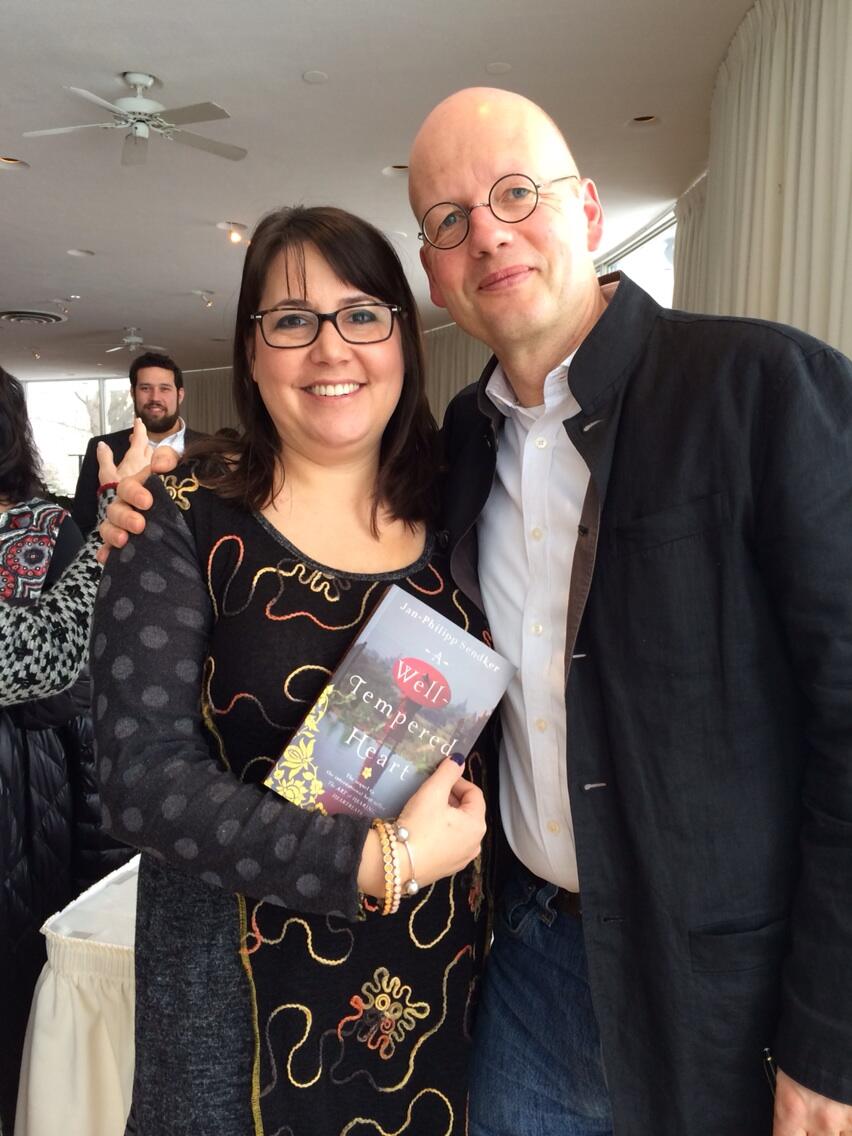
1489183383Jan-Philipp Sendker, a journalist, was inspired to write his lovely novels because of a specific place — Burma. He had never considered writing fiction before, but after a visit to Burma on a journalistic assignment in 1995, his imagination was sparked. The result was The Art of Hearing Heartbeats, a love story between a blind man and a crippled girl. It’s a story that Jan-Philipp says could only have happened in Burma. The book, written in German, was eventually translated into English and became an American bestseller — as well as one of Lake Forest Book Store’s bestselling books of all time. He visited Lake Forest for a luncheon when The Art of Hearing Heartbeats was published in the United States, and we were thrilled to welcome him back last week when he was on tour for the sequel, A Well-Tempered Heart.

Jan-Philipp Sendker with a fan

Jan-Philipp had no intention of writing a sequel —  and in fact was almost finished with a novel set in China —  but while daydreaming in a teahouse in a Burmese village, he became obsessed with the thought of continuing Julia’s story. And while traveling through the country, he encountered a Burmese man who had spent eight years in captivity for crimes he didn’t commit, who explained that only by forgiving his captors could he set himself free. Jan-Philipp put aside the novel he was writing and wrote A Well-Tempered Heart, about what he calls the “difficult art of forgiving”.  As I listened to Jan-Philipp describe his travels in Burma and how his novels came to be, I also thought — as I often do at author events —  about how lucky readers are, in this digital age, to hear an author speak from the heart. Jan-Philipp told us he’s writing a third book in the series, so we’re hoping he returns to Lake Forest.

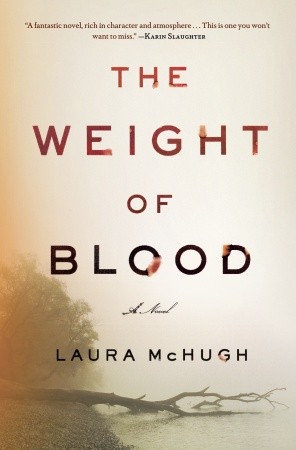
www.randomhouse-1I have to mention one more new book in which setting plays a crucial role — Laura McHugh’s debut novel, The Weight of Blood. Set in an isolated, unwelcoming small town in the Ozarks, this dark and suspenseful novel tells the story of two missing women — Cheri, a mentally handicapped teenager, and Lila, a young mother. This book, which reminded me a little of Gone Girl, kept me up late at night. I’ve never been to rural Missouri (and after reading this book, I’m not sure I want to!), but I feel as if I’ve been there — and the region seems nearly as foreign as Burma or Chechnya. In an interview with Shelf Awareness, Laura McHugh, who grew up in the Ozarks, explains why she set her book there:

The forbidding landscape and the remoteness of the Ozarks create a sense of foreboding that helps set the tone of the novel. And I’ve always been fascinated by the culture, which is steeped in folk wisdom, home remedies, and superstition. We were outsiders in our tiny town, yet at the same time, it became my home. Years after moving away, I was still haunted by the place, and the novel allowed me to explore the darker side of those tight-knit rural communities where outsiders aren’t welcome.

What’s next for me? I’ve just started The Headmaster’s Wife by Thomas Christopher Greene, set in familiar territory — New York City and Vermont. (This book is not to be confused with The Headmaster’s Wager or The Headmaster’s Dilemma . . . or two other books called The Headmaster’s Wife.) I’m already finding that while the geography is familiar, the story and the characters are wonderfully surprising.

What’s In a Name? 10 Favorite Book Titles

From Bookriot.com.
From Bookriot.com.

What’s in a name? That which we call a rose
By any other name would smell as sweet.

Does Juliet’s famous quotation hold true for the titles of books as well? It’s hard to imagine these famous books with the titles their authors first contemplated:

  • The Great Gatsby was originally going to be called Trimalchio in West Egg or Under the Red, White, and Blue.
  • The working titles of Gone With the Wind were Tote the Weary Load or Mules in Horses’ Harnesses.
  • The Sound and the Fury (“the best-titled book of all time”, according to Book Riot) started out as Twilight.

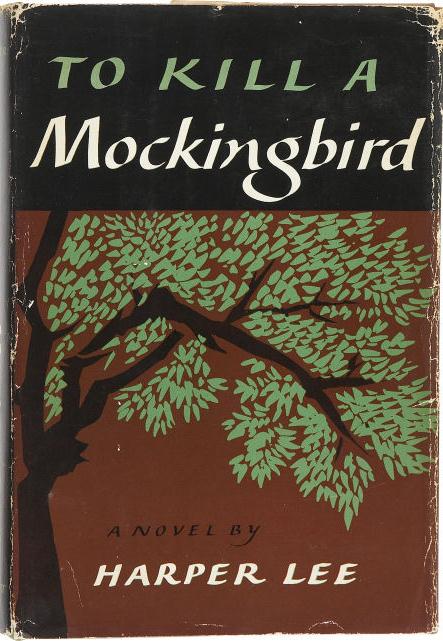
To-Kill-a-Mockingbird-First-Edition-CoverI’d vote for To Kill a Mockingbird as one of the best titles of all time. It’s a memorable and poetic title that hints at the central theme of the book without revealing too much. Harper Lee settled on the title after discarding two others, Atticus and Go Set a Watchman. I’m glad she didn’t name her masterpiece after the book’s hero. I confess to a bias against book titles that are the same as the main character’s name. Pride and Prejudice strikes me as a much better title than Emma, for example. Emma is so much more than a character study — why did Jane Austen decide to name the book after the protagonist? Books named after their protagonists seem to indicate a lack of originality on the part of their authors, but I know that’s not the case. Charlotte Bronte (Jane Eyre), Leo Tolstoy (Anna Karenina), and Charles Dickens (David Copperfield, Oliver Twist, Nicholas Nickleby) certainly didn’t suffer from a lack of originality. Maybe I am overemphasizing the significance of titles?

People are often surprised to learn that book titles can’t be copyrighted. Many times, we’ve had customers ask for a particular book without knowing the author’s name, only to find out that there are many books with the same title. I don’t know why anyone would choose a title that’s been used over and over, but it happens all the time. For example, a customer recently came in asking if we had The Dressmaker. A book with that title by Kate Alcott came out last year, and I assumed that’s the one the customer wanted. But when I described the plot (the dressmaker is a personal maid on the Titanic and ends up in a lifeboat), the customer said that wasn’t the book she wanted. I found four other books called The Dressmaker, but none of those was the one the customer had in mind. (It turned out she wanted Mrs. Lincoln’s Dressmaker by Jennifer Chiaverini . . . not to be confused with Mrs. Lincoln’s Dressmaker by Lynda Jones.)

Authors today typically don’t have total control over their books’ titles. They may be attached to a certain title, only to be told after an editorial or marketing meeting that the title is deemed inappropriate for various reasons. In an interview on The Awl (a great website that covers publishing and “the issues of the day”), author Laurie Frankel (The Atlas of 9780307947727Love) describes her experience working with her publisher to choose a book title:

I can only explain how I learned to stop worrying and love the title. My agent, who knows much more about writing and selling books than I do, loved it. My publisher, who knows much more about writing and selling books than I do, loved it. My editor, who had been as attached to Naked Love and its titular moment as I was, loved the new title . . . Meanwhile, at work on novel number two, I have a working title I refuse to get emotionally attached to. And this niggling reminder I learned in kindergarten and have clung to ever since: it’s what’s inside that counts.

9780670026630HLaurie Frankel is absolutely right, but I still love an unforgettable title that perfectly captures the essence of the book.  Here are 10 of my favorites (including both classics and recent books) — what are yours?

  • The Sense of an Ending (Julian Barnes)
  • Wuthering Heights (Jane Bronte)
  • Tell the Wolves I’m Home (Carol Rifka Brunt)
  • A Hologram for the King (Dave Eggers)
  • The Art of Fielding (Chad Harbach)
  • A Tale for the Time Being (Ruth Ozeki)
  • Where’d You Go, Bernadette? (Maria Semple)
  • A Tree Grows in Brooklyn (Betty Smith)
  • Angle of Repose (Wallace Stegner)
  • The Warmth of Other Suns (Isabel Wilkerson)

And one more thing: I have to mention how much I hate it when the publisher adds a subtitle to the title of a novel, which they seem to do more and more frequently. Immediate turnoff. For example, Sebastian Faulks’s Birdsong is one of my favorite books. Below the title on the  current paperback cover, it says “A Novel of Love and War“. I think the reader can probably figure that out. What’s next? War and Peace: A Novel of War and Peace? The Scarlet Letter: A Novel of Infidelity?


To Review or Not to Review?

I don't think this is the best approach to book reviewing.
I don’t think this is the best approach to book reviewing.

Any reviewer who expresses rage and loathing for a novel is preposterous. He or she is like a person who has put on full armor and attacked a hot fudge sundae. — Kurt Vonnegut

There’s been a lot of controversy recently about negative book reviews.  The New York Times Book Review tackled this topic a couple of weeks ago, with opposing viewpoints presented by Francine Prose and Zoe Heller. Prose asks, “Why would a sensible writer ask people not to buy a book? If the novel, as we also hear, is moribund or dead, why drive another nail into its sad little coffin?” Heller counters with the argument that authors “write for other people. They write to have an effect, to elicit a reaction . . .  they are not kindergarteners bringing home their first potato prints for the admiration of their parents, but grown-ups who have chosen to present their work in the public arena.”

So, if a critic has a negative reaction to a book, should that reviewer decline to publish the review? This is what Prose advocates: “I began returning books I didn’t like to editors. I thought, life is short, I’d rather spend my time urging people to read things I love.” I sympathize with her point of view. As a bookseller and book blogger, I’d prefer not to spend time telling people about books I found pretentious, or boring, or poorly written. (But if anyone asks me, I’m happy to oblige! I have to maintain credibility.) However, I’m not a professional book critic. I look to critics such as Prose and Heller to provide me with guidance. When I read a book review, I want to see evidence that the reviewer is a critical thinker.  If I wanted to see “5 stars!!! Best book ever!” I could look at Goodreads.

Fewer and fewer newspapers and magazines publish book reviews; in fact, many major newspapers have eliminated their book sections. The Chicago Tribune reinvented their book section in 2012, calling it “Printers Row” and making it available only as a supplementary print or digital subscription. It’s described as “the Chicago Tribune’s literary journal, fiction, and membership program”. I appreciate that the Tribune is making an effort to keep literary criticism alive in a major newspaper. In fact, Printers Row doesn’t seem to have any problem publishing negative reviews. I just wish they’d agree with me more often on which books to review negatively! We are definitely not on the same page, so to speak.

I was captivated by the main character's voice in this inventive novel.
I was captivated by the main character’s voice in this inventive novel.

A case in point is the recent review of The Sun and Other Stars, by Brigid Pasulka (a Chicagoan), written by Troy Jollimore, a poet, philosophy professor, and book critic. Jollimore claims that the novel shows a “preference for sentimentality over real emotion”.  Calling a literary novel “sentimental” is fairly harsh. But how does a critical reader determine if a novel is sentimental? Jollimore tries to back up his claim with examples from the novel; for instance, he states that the tragic events in the novel are “plot devices” that are “exploited” to move the story forward. Hmmm . . . sounds a little bit like Supreme Court Justice Potter Stewart defining pornography by saying “I know it when I see it”. Aren’t all tragic events in fiction plot devices to a certain extent?

My response to the novel could not have been more different. I found the novel genuinely moving and the characters well-developed and believable. The Sun and Other Stars takes place in a small village on the Italian Riviera. Etto, the protagonist, is the 22-year-old son of the village butcher. His twin brother, a “calcio” (“soccer”, in American parlance) star,  has recently died in a motorcycle crash and his grief-stricken mother committed suicide not long afterwards. Etto and his father exist in their own separate orbits, unable to connect with each other. When Yuri, a famous Ukrainian calcio player, comes to San Benedetto for the summer, everything changes for Etto and his father — especially after Etto meets Yuri’s beautiful sister.

The book, which is in many ways a love letter to all things Italian, takes its title from the final lines of Dante’s Divine Comedy:

But already my desire and my will
were being turned like a wheel, all at one speed,
by the Love which moves the sun and the other stars.

Just as Dante survives the horrors of hell and comes to know God’s love, so does Etto survive despair and grief and come to know love again. Calcio, which had separated him from his father and his fellow villagers, brings them together. Yes, the story has all the makings of a romantic comedy, but it never becomes hackneyed or predictable. Brigid Pasulka gives Etto a completely original and endearing voice, filled with melancholy and black humor.

The first knock of the morning plinks against the window, the start of the procession of nonne on their way to mass. Nonne, nonne, nonne, and more nonne. This is what sociologists call the aging of Europe, and Liguria’s demographics are the most top-heavy of them all, crammed with nonne, nobody stupid or naive enough to bring more babies into this world. They clutch each other’s arms, crossing the front windows so slowly, you can see the gossip gathering in clouds over their heads . . . the nonne take to the streets every morning without fail.  After all, they’re in training. They must have strong backs to prop up the 80 percent of us who have stopped hedging our bets with God.

Besides being the only man in San Benedetto who isn’t obsessed with calcio, Etto is set apart in another way: he is half American. Calcio brought his parents together; they met at a soccer match and fell in love despite a language barrier. But art is what bonded mother and son:

Mamma used to be as passionate about art as Papa is about calcio. It was the reason she came to Europe in the first place, because she said she was tired of learning art history from slides, and tired of being in California, where there was nothing older than she was. . . She could make any museum interesting, even when I was a kid. She would take me around to each sculpture or painting as if she was introducing me to old friends.

Etto decides to paint a replica of the Sistine Chapel in his old high school, replacing the Biblical figures with San Benedetto villagers. He says, “You are probably shaking your head, thinking, what kind of deficiente thinks he will be able to paint a copy of the Sistine Chapel on the ceiling of a classroom? What kind of arrogant stronzo?” This final tribute to his mother enables him to start coming to terms with the grief and anger he feels over her death.

Readers will notice that Italian words are sprinkled throughout the novel without italics — or explanation. At first, I found this slightly distracting — and then, as I learned their meanings, I found it brilliant. Etto is bilingual, and most likely thinks in both Italian and English. Pasulka’s use of language in this way enriches his voice and makes him seem even more real.

Obviously, the Printers Row reviewer didn’t share my enthusiasm for The Sun and Other Stars. Besides missing the genuine emotion that was so evident to me, he missed the beauty of the language and the originality of the story. I thought Pasulka masterfully combined love, tragedy, art, and sports to create a wonderfully inventive novel.

To read the full article about the pros and cons of negative book reviews, click Do We Really Need Negative Book Reviews?

5 Reasons to Read Short Stories

Collections of short stories are hard to sell. I can almost predict the response when I offer a book of short stories to a customer:

ME: What can I help you find this afternoon?

CUSTOMER: Well . . . I’m just looking for something good to read. Anything you’ve read lately you would recommend?

coverME: Oh, yes! I really enjoyed Astray by Emma O’Donoghue. She wrote Room.  It’s a collection of short stories, and I thought just about every story was wonderful.

CUSTOMER: Uh-huh . . . I wasn’t really looking for short stories. Anything else?

And booksellers aren’t the only ones who have trouble convincing people to read short stories. Author David Abrams has the same problem, as he notes in the website Book Riot:

I’ve always been a champion of the short story, both as a writer and a reader, and it always stuns me into silence when I have friends–good friends, well-read, intelligent, reasonable friends–who dismiss short stories with a flap of the hand, a pinch of the lips, and a deprecating, “Oh, I don’t do short stories.” It’s said in the same tone of voice a vegetarian would say, “I don’t do meat.” When I come back with, “Why not?” the answers are always vague and insubstantial. I have yet to find anyone who can give me a solid, tangible reason they don’t like short stories. I suspect they’re afraid of short stories, an aversion that began in grade school . . . By their nature, short stories compress language to its densest gem-like state (second only to poetry); novels sprawl and emphasize plot and are generally more accessible to younger readers. I could be wrong, but I think the average 15-year-old would rather read The Catcher in the Rye than “Young Goodman Brown.”

bernice_covWriters themselves have a hard time selling their short stories. Most are grateful if their stories see print in obscure literary magazines. This wasn’t always the case. In the 1920s, F. Scott Fitzgerald was able to support a lavish lifestyle through sales of short stories to popular magazines; the Saturday Evening Post paid him as much as $4,000 for a single story. In 1930, Edith Wharton sold a story to Cosmopolitan for $5,000.  (Imagine how much that would be in today’s dollars!) Writers used the income from short stories to support themselves as they worked on novels. Now, writes critic A.O. Scott in the New York Times, “A young writer who turns up at the office of an editor or literary agent with a volume of stories is all but guaranteed a chilly, pitying welcome. That kind of thing is just not commercial.”

I’ve been reading that the short story is experiencing a resurgence. It’s true that Alice Munro, arguably the best short story writer of our time, won the Nobel Prize for literature in 2013, and that George Saunders was a 2013 National Book Award finalist for his short story collection, The Tenth of December.  And digital publishing may be revitalizing the short story; in an article in the New York Times entitled “Good Fits for Today’s Little Screens: Short Stories”, Leslie Kaufman writes, “The Internet may be disrupting much of the book industry, but for short-story writers it has been a good thing.” She quotes Amber Dermont, a novelist who has recently published a short story collection: “The single-serving quality of a short narrative is the perfect art form for the digital age . . . Stories are models of concision, can be read in one sitting, and are infinitely downloadable and easily consumed on screens.”

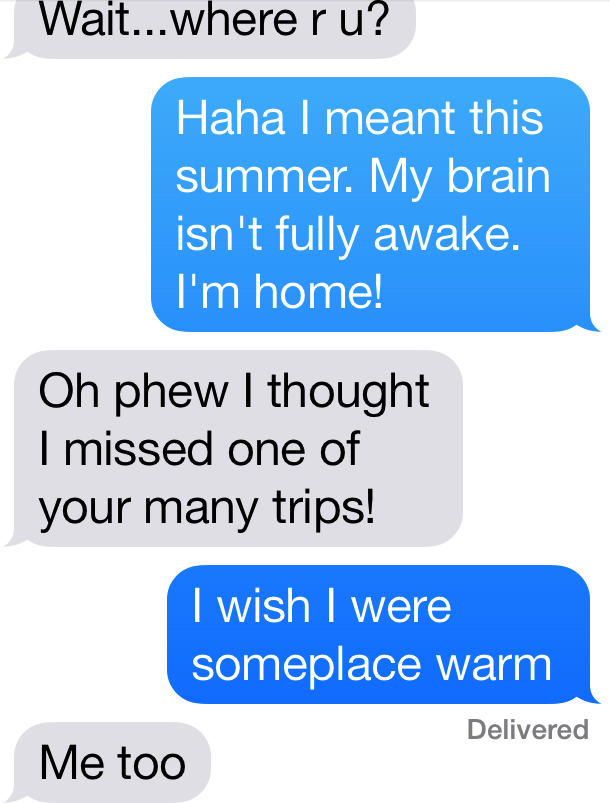
A typical text conversation of mine. Not a shining example of how digital technology enhances writing skills.

In the same article, Cal Morgan, an editor at HarperCollins, says that digital communication has had a positive influence on younger writers:

The generation of writers out of college in the last few years has been raised to engage with words like no generation before. Our generation was raised on passive media like television and telephones; this generation has been engaged in writing to each other in text messages on a 24-hour basis. I think it has made them bolder and tighter.

Hmmm, I’m not sure if texting makes anyone’s writing “bolder and tighter”, and I really don’t think the new generation of writers has “been raised to engage with words like no generation before” — but I appreciate the attempt at putting a positive spin on round-the-clock texting.

Here’s my sales pitch for short stories:

  1. They’re . . .  short. When you’re between books, or don’t have the time to immerse yourself in your current book, it’s very satisfying to read a thoughtful, well-written story. You feel like you’ve accomplished something. And there are many stories you can read in 10 or 15 minutes . . . stories that you will be thinking about for much, much longer than that.
  2. They’re usually very well-written.  Writers who are able to publish collections of short stories are generally well-established literary writers. It takes a tremendous amount of skill to write a good short story. Even if you scratch your head trying to figure out what the story was really about, you will appreciate the writing.
  3. They’re perfect for book clubs. No one can show up to your book club without having read the selection — anyone can find the time to read a short story or two. How about a meeting where you compare two short stories? A discussion based on a story might actually last longer than a discussion of The Goldfinch — especially if only two members of your group have finished it and the rest don’t want the ending ruined.
  4. They are wonderful to listen to or to read aloud. I really enjoy the NPR Selected Shorts podcasts. I find it hard to listen to audiobooks; I keep losing track of the plot. But short stories are ideal for car trips or walks.
  5. They lend themselves to rereading. I’m much more likely to reread a short story than a novel. I’m often amazed by how much more I appreciate a story when I read it again. I’m sure I’d feel the same way if I reread I novel, but I rarely do that; there’s always another book waiting.

I recommend starting with a short story anthology so you can read what an editor considers the best stories by top short story writers. I love the Best American Short Stories series, which comes out in paperback every fall. Each year, there’s a different editor, who’s a well-respected author; the 2013 volume is edited by Elizabeth Strout. The O. Henry Prize Stories series is also wonderful. I can almost guarantee that if you pick up any book in either of these series, you will find at least one story that speaks to you.

cover-1Here’s a list of 10 favorite short story collections, new and old:

  • What We Talk About When We Talk About Anne Frank by Nathan Englander
  • Different Seasons (4 novellas) by Stephen King
  • Bark by Lorrie Moore (due 2/25/14)
  • Dear Life by Alice Munro
  • The Complete Stories by Flannery O’Connor
  • Nine Stories by J.D. Salinger
  • Selected Stories by William Trevor
  • Collected Stories and Other Writings by John Cheever
  • Unaccustomed Earth and Interpreter of Maladies by Jhumpa Lahiri

Next on my list? The News from Spain by Joan Wickersham.

Further reading on short stories:

A Brief History of the Short Story in America (Critical Mass, blog of the National Book Critics Circle of America)

Sorry, the Short Story Boom is Bogus (Salon)

Brevity’s Pull: In Praise of the Short Story (New York Times)

Good Fit for Today’s Little Screens: Short Stories (New York Times)

20 for 2012: Short Story Collections (Book Riot)

Reading on a Jet Plane

All my books are packed, I’m ready to go . . .  (apologies to John Denver and Peter, Paul & Mary)

Last week, I went to the American Booksellers Association Winter Institute in Seattle — a four-day educational conference for independent booksellers. Packing my clothes was easy; people in the book business are not known for being fashion-forward, and January in Seattle does not require the layers of fleece, wool, and down that are needed in Chicago. So after I filled my carry-on suitcase with jeans, yoga pants, and sweaters, I started the difficult task of deciding which books to take — always the trickiest part of trip preparation.

9780062279972-1What about the book I’m reading that only has 50 pages left to go — worth bringing, when I might finish it at the gate before the plane even takes off? And that big, fat, HEAVY new hardcover — what if I haul it along and end up hating it? Should I bring something that I’m obligated to read so I can’t keep putting it aside the way I do at home? How about something mindless that I can leave behind?  I always bring 150% of the books I think I’ll have time to read on a trip– ever since I was delayed overnight in the Frankfurt Airport, where I ran out of reading material and was forced to buy the only non-pornographic English language option available, The Sum of All Fears by Tom Clancy. Now my greatest fear is being stranded without a good book, or two, or three.

And yes, I do know about e-books. They’re fine; I have my IPad loaded with them. I just don’t enjoy reading them the same way I enjoy reading real books. They serve the purpose the same way eating at McDonald’s does the job when you’re on a road trip. I’d rather eat at McDonald’s than go hungry, but I don’t feel nourished the same way I would if I ate real food. And besides, what happens when the e-reader runs out of juice and there’s no power supply available, or it malfunctions?

As I was pondering my book options for the trip, it dawned on me that I really only needed to bring two books — one to read on the four-hour flight to Seattle, and one for “insurance” in case of delays. After all, I was going to a booksellers’ conference where I was going to be given dozens of wonderful new books to read and share with my colleagues. So what did I bring? The Wind Is Not a River, by Brian Payton (which I’d just started reading but knew I was going to love) and Careless People: Murder, Mayhem and the Invention of the Great Gatsby by Sarah Churchwell (which I wanted to finish reading because the author is coming to Lake Forest for an event in February).

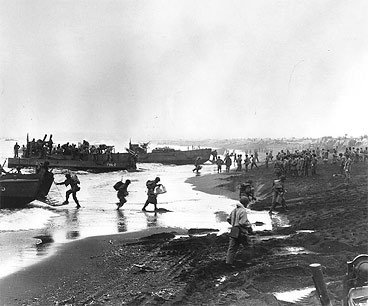
The Wind Is Not a River is my favorite kind of book — it’s a war story and a love story, and it focuses on a somewhat obscure piece of history. Set in Seattle and Alaska during World War II, the novel contains two narratives. Journalist John Easley impersonates a Royal Canadian Air Force officer to investigate the Japanese invasion of the Aleutian Islands in Alaska. (The U.S. authorities didn’t allow journalists to cover the invasion since they felt Americans would panic if they knew how close the Japanese actually were to America’s mainland.) He accompanies an American crew on a bombing run over the islands and is shot down. For months, he lives in a cave, foraging for food and evading the Japanese occupiers. Meanwhile, his wife Helen passes herself off as a showgirl and joins a USO group headed to Alaska to entertain the troops — but her real purpose is to track down her missing husband.

The Battle of Attu, the only World War II land battle in North America.

Author Brian Payton expertly moves between the two stories, which are equally compelling. John’s battles against starvation and gangrene and Helen’s desperate attempts to get information from unwilling officials are both vividly rendered. His writing beautifully evokes the stark, unfriendly landscape of the Aleutian Islands. In her review in the Chicago Tribune, Beth Kephardt says: “Payton’s great gift is characterizing a specific place and time; I would read anything Payton writes about landscape.”  (To read the complete Chicago Tribune review, click Chicago Tribune/Printers Row.)

Soon after John is shot down, he meets another survivor — a young airman from Texas. Payton describes their encounter in language that perfectly evokes the scene, yet makes me think of E.B. White’s rule for writers — “Omit needless words”:

Then, just as swiftly as it began, the fog stalls its retreat. Like a wave racing down the beach to the sea, it hesitates, reverses course, then comes flooding back again. They walk toward each other in the gathering mist, the preceding color and light now seeming like a dream. They approach each other with widening grins, like they’re the only ones in on the joke. And when they meet, they hug each other long and hard, like men who had cheated death together — like men convinced the worst is behind them.

Of course, the worst is not behind them. The journey ahead for John Easley and Karl Bitburg will test their courage and endurance — just as Helen’s search reveals the strength and determination she never knew she had.

I closed The Wind Is Not a River just as the plane was beginning its descent into Seattle. As I looked out the window at the gorgeous scenery of the Pacific Northwest, I imagined Helen Easley boarding the ship that would take her to the Aleutian Islands to look for her husband. I had to remind myself that what I’d just read was historical fiction, and that Helen and John never existed. But they seem just as real to me as Zelda and F. Scott Fitzgerald do in Careless People, another book with two narratives. In the fall of 1922, Scott and Zelda moved to Long Island; around the same time, in nearby New Jersey, a double murder (a married minister and his mistress) took place. In her well-researched work of history and biography, Sarah Churchwell connects these stories in surprising and insightful ways.  Next week, I’ll be interviewing Churchwell, an American literature scholar currently living in England. I hope she has a peaceful plane trip, with plenty of time to read!

Do You Keep a Reading Journal?

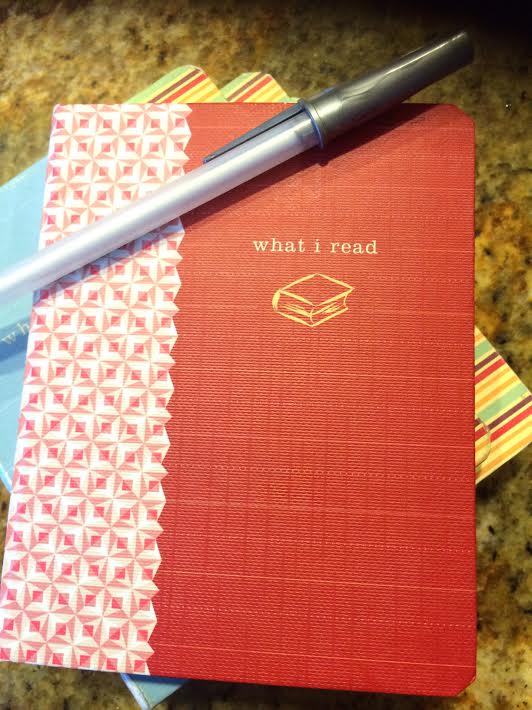
Gloria's book journal
Gloria’s book journal

One of the unexpected pleasures of Books on the Table has been reconnecting with old friends. I recently heard from Gloria, who worked at Lake Forest Book Store for several years and then moved to Door County, Wisconsin. Gloria, who had a rewarding career as a nurse, turned to bookselling later in life.  Her first job was at Borders back in the days when applicants had to take a difficult test to prove their “bookworthiness”.  In response to “10 Books I’d Save in a Fire (or a Flood)”, Gloria commented:

When I was a child my family home had two devastating fires (one electrical/smoking related and the other set by a sibling playing with matches). No one was ever hurt but many treasured possessions like books and photos were lost. Then as a young mother, I lost my children’s baby pictures to a cold-hearted burglar. So . . . my mind is prepared and my old childhood books are already gone. (After reading two of my current recommendations, Ru and A Constellation of Vital Phenomena, I place my losses in the perspective where they belong.) What I would save now are these little ‘What I Read’ journals. For the last several years I write a short synopsis of everything I read; include the date, my reaction, little tidbits like “bought off the table at LFBS(!)” or “read during January 2014 deep freeze”. As I get older I sometimes don’t remember what I had for dinner last night….these journals refresh my memory of all the many great, and occasional not so great, books I’ve read. I know people who’ve done this much of their lives. Lucky them!

Gloria has met many other book lovers in Door County, including one who has little boxes filled with index cards with information about books she’s read, and one who has a list of all the books she’s read going back to high school. That’s impressive — although when I was in high school, I did have a little journal full of “meaningful” quotes from poems and songs. I would be embarrassed to read that now, especially when I recall that one of those quotes was from the Grateful Dead: “What a long, strange trip it’s been”.

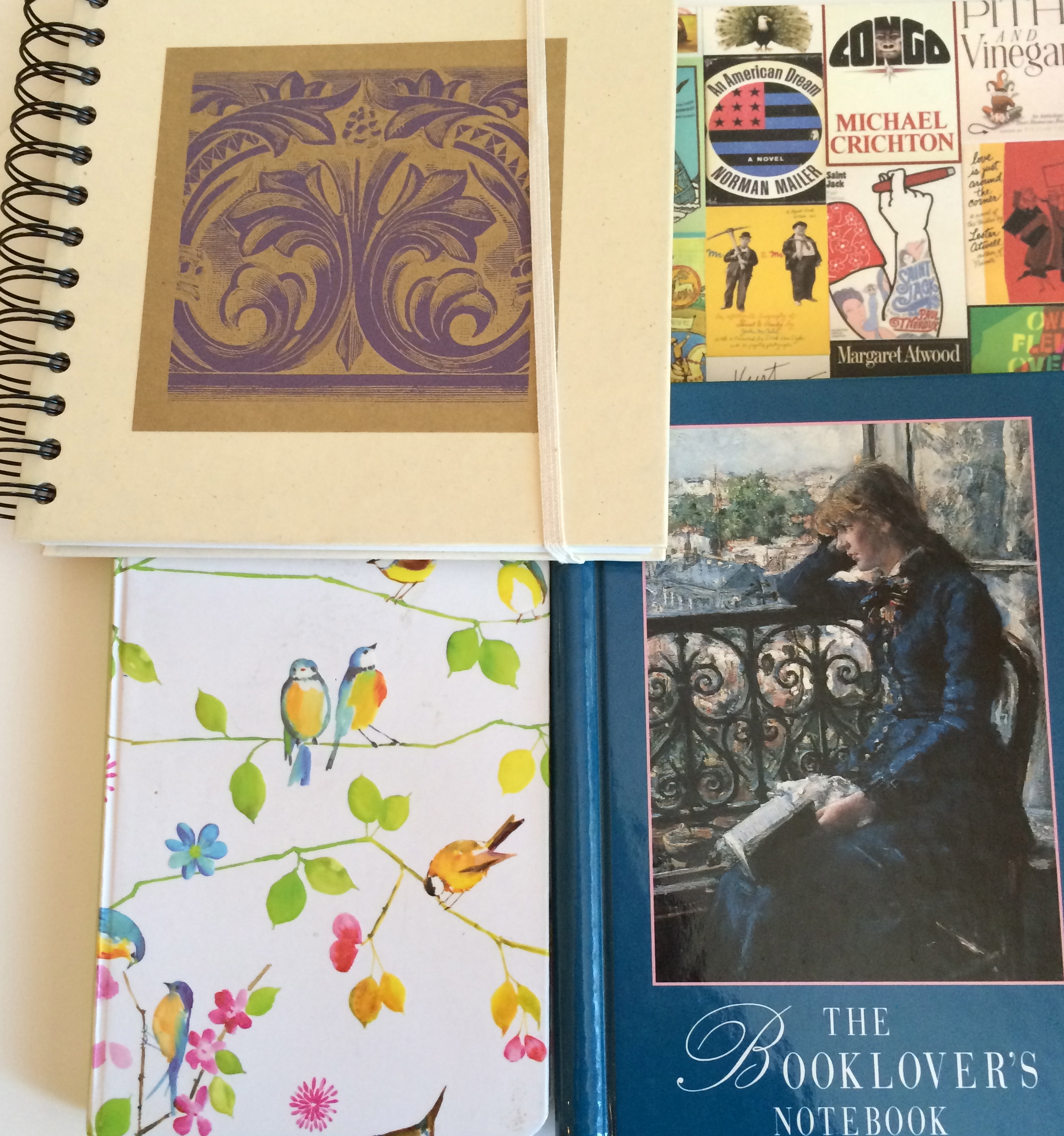
My collection of book journals -- not a word has been written in any of them.
My collection of book journals — not a word has been written in any of them.

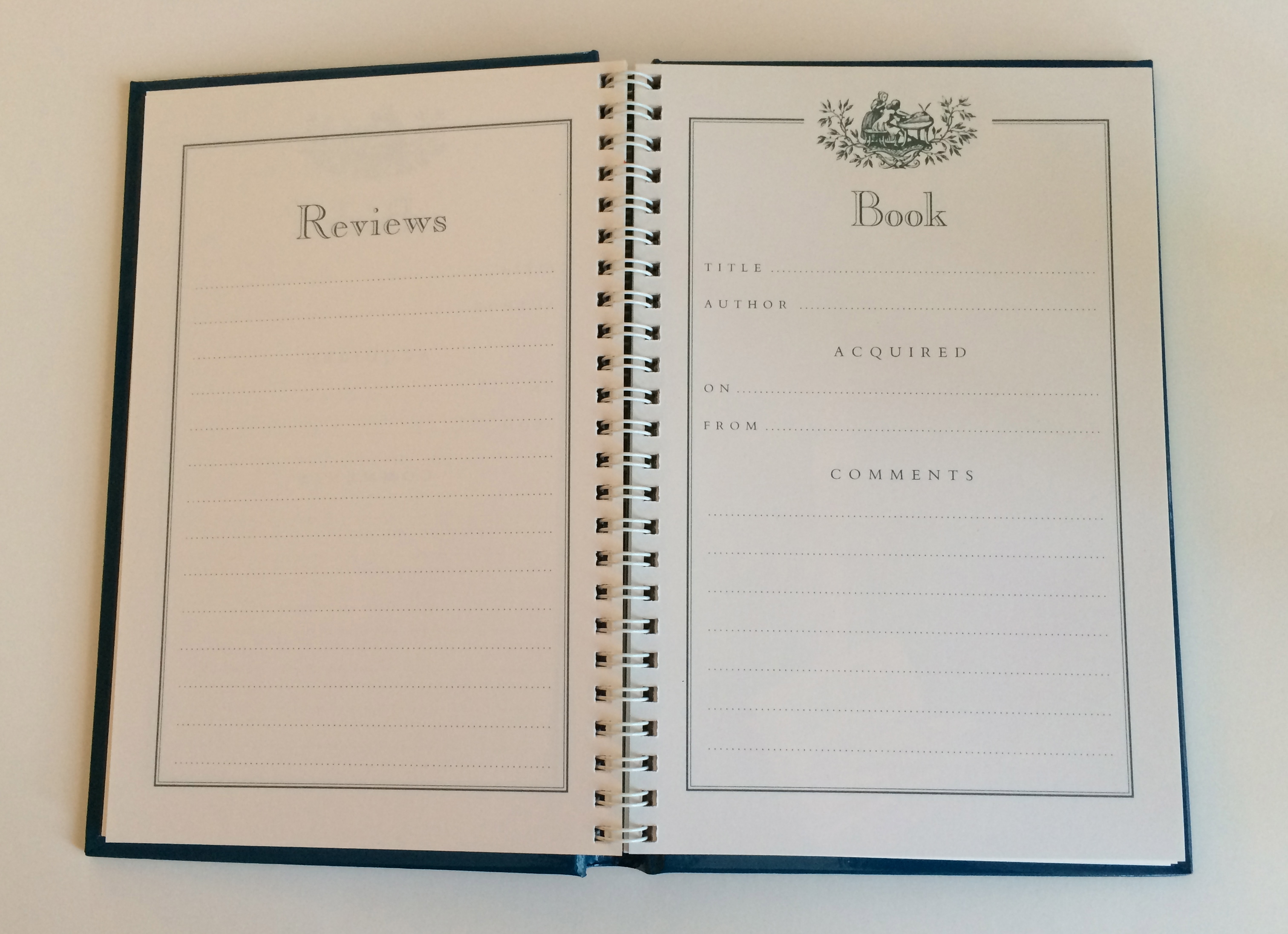
I’ve never kept a book journal. I have a collection of  lovely blank books that I bought with the intention of keeping track of the books I’ve read (and want to read)  but those books are still empty. Every time I bought a beautiful hardbound journal, I thought that would be the one that would inspire me to record my reading. Now, I’m trying to remember to list my books  on the “Recently Read” and “In My Stacks” pages of Books on the Table, but I’m not even doing very well with that. I wish I’d kept a journal of all the books I’ve read, starting in childhood. This year, I’m going to keep track of the books I’ve read, and I’m going to keep a list of books I plan to read. It’s certainly an easier resolution to keep than losing 10 pounds or working out every day!

Apparently, even successful authors have difficulty remembering to use their reading journals. While procrastinating this morning, I found a post called “The Reading Resolution” on the Jungle Red Writers (“smart and sassy crime fiction writers”) blog. Deborah Crombie says:

I have attempted, on numerous occasions, to keep track of WHAT I read. I have a book journal, with, well, maybe three pages filled out.  I’ve put books in my personal journal, occasionally. (And don’t ask how long it’s been since I made an entry in that!)  I’ve made notes on what I’m reading now and again in my calendar.

Deborah’s fellow author, Julia Spencer-Fleming, admits to the same problem:

What I DO want to try in 2014 is keeping a book journal. I get so frustrated when someone asks me, “what are you reading?” or we do

The pristine pages of one of my book journals.

one of our book recommendation posts here on JRW, because half the time, I can’t recall the name or author of the great book I devoured just last month!

Does anyone have any suggestions for a really good-looking book journal to make it easier for me?

I’m sorry, Julia, but I have some very good-looking journals and they haven’t made it any easier for me . . . good luck!

To read “The Reading Resolution” blog post, click Jungle Red Writers. Contributors to the blog are Deborah Crombie, Julia Spencer-Fleming, Hallie Ephron, and several other mystery/suspense novelists.